
Galaktoboureko: custard, phyllo and the syrup between them
Γαλακτομπούρεκο
Read galaktoboureko through its semolina custard, fragile phyllo and syrup, with a comparison of published Greek recipes and practical serving cues.
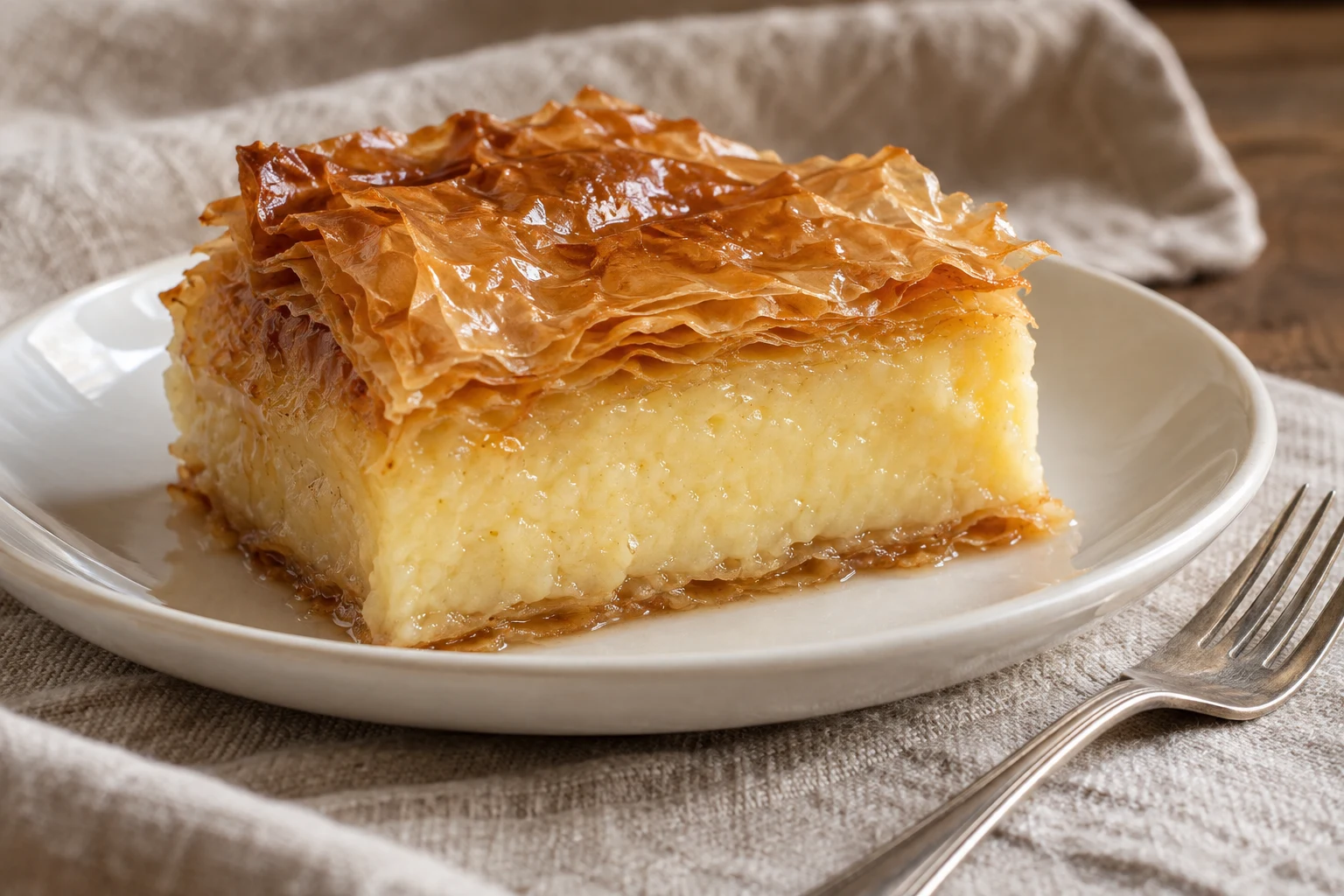
The side of a slice tells the story
Galaktoboureko is a Greek syrup-soaked pastry with a substantial milky custard inside thin phyllo. The official Athens guide describes semolina as the custard's thickener and the syrup as a finishing step after baking. A cut portion makes that construction visible: a soft centre, fragile sheets above it and a moist lower edge.
Try approaching the first bite through those textures. Take a little of the upper pastry with the custard, then notice the base separately. This is a useful tasting exercise rather than a rule about the perfect slice. The dessert's appeal depends on the parts meeting each other, and a photograph of the top alone hides much of that relationship.
Three parts, three jobs
- Centre
- Semolina custard
- Shell
- Buttered phyllo
- Finish
- Citrus-scented syrup
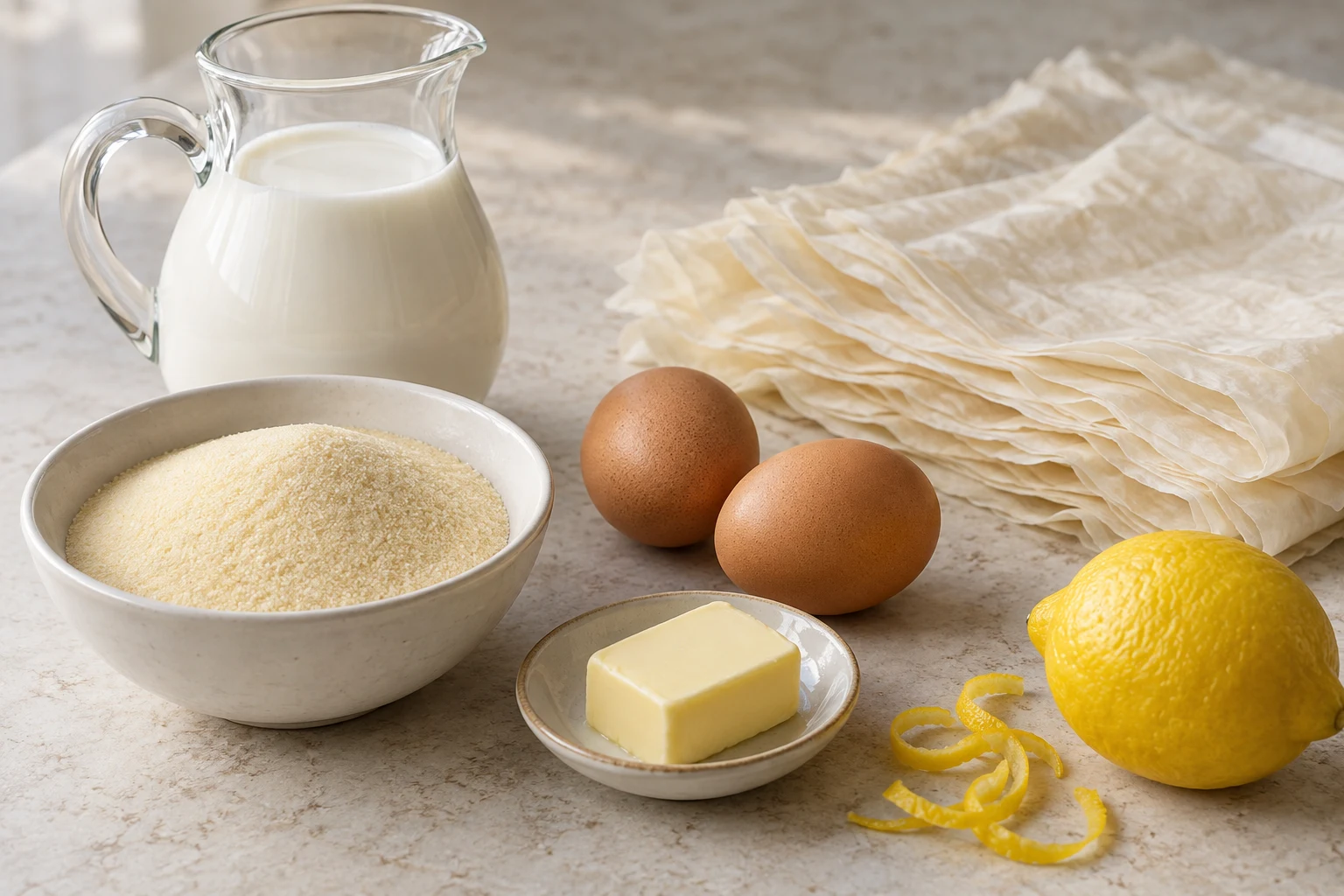
Milk, eggs and fine semolina appear across the recipes compared here.
Thin sheets surround the filling; the top is scored before baking.
Sugar syrup is applied after baking, with temperature instructions that vary by author.
Fine semolina changes the filling
Eli K. Giannopoulos's My Greek Dish recipe explicitly calls for fine semolina and describes a slight graininess as part of this custard's character. His version combines milk with cream and separates the eggs, folding whipped whites and beaten yolks into the prepared filling. Those choices belong to that particular formula; they are not requirements for every galaktoboureko.
Argiro Barbarigou takes a different route. Her recipe warms milk with cinnamon and lemon zest, then brings some of that milk into the egg mixture before returning it to the pan to thicken. Reading the two methods side by side is more useful than selecting isolated steps from each. The egg handling, dairy mixture and sequence work together within their own recipes.
A shared structure allows different seasoning
Argiro's aromatic milk
Cinnamon and lemon zest flavour the milk; the recipe also uses vanilla. This is one published approach to a fragrant custard.
Minerva's citrus pair
The Greek food producer's version uses both orange and lemon zest in the filling, with cinnamon and cloves in its syrup. The citrus profile is therefore a meaningful difference, even though the pastry structure remains familiar.
Read the pastry instructions before opening the packet
My Greek Dish warns that phyllo dries quickly and advises keeping it covered while working. The same author chooses to sprinkle butter over the sheets. Minerva instead specifies buttering each sheet, arranging half underneath the cream and the rest above it. These are published methods to compare, not evidence that one gesture defines the dessert.
Before assembling, read how your recipe handles overhanging sheets and scoring. Minerva folds the lower sheets over the filling and marks the top into squares. Think of those instructions as part of the construction: the custard must be enclosed and the eventual portions planned. A complete recipe should also tell you its pan and baking conditions; this article does not supply a substitute formula.
Syrup temperature is a recipe instruction
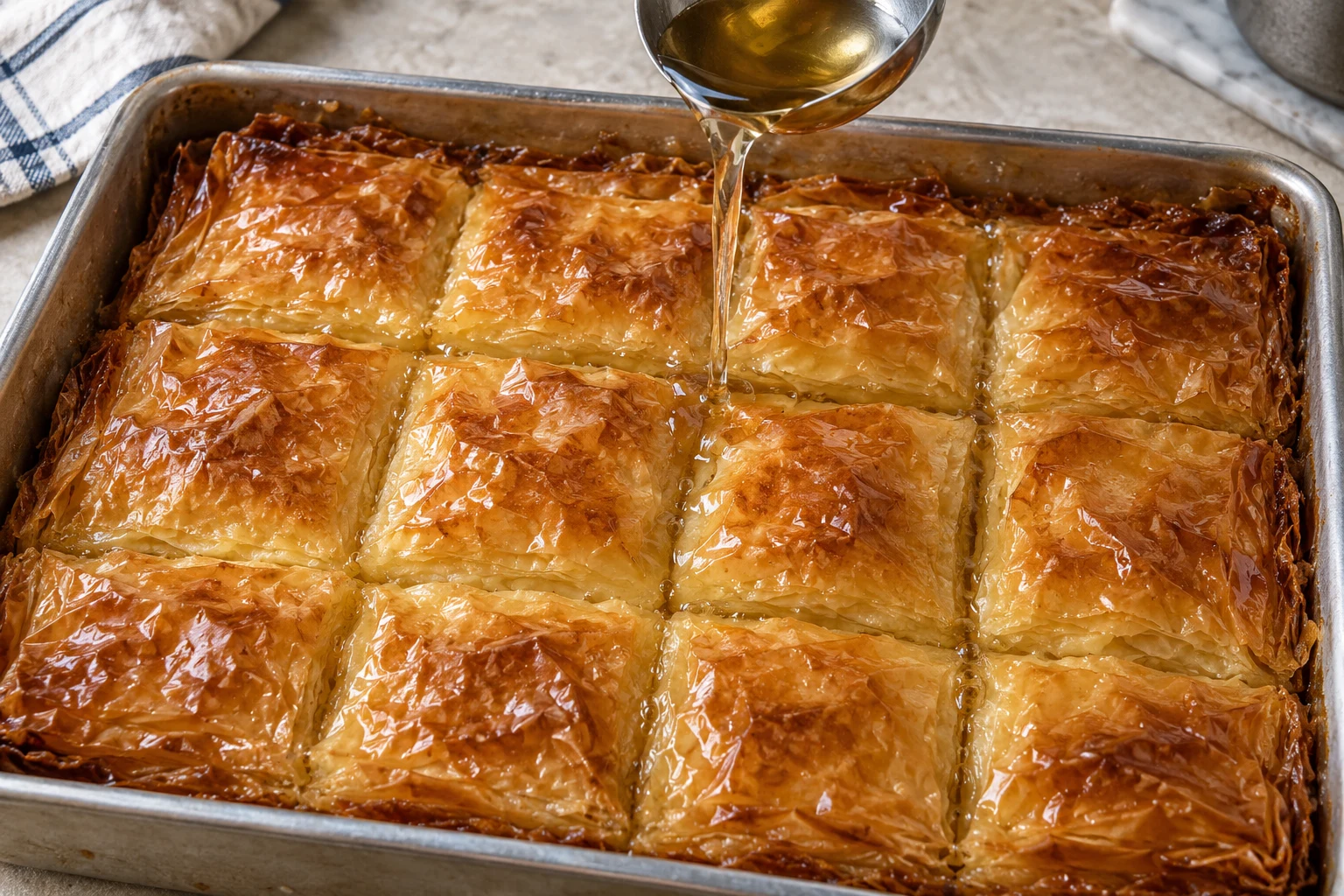
Argiro directs cooks to pour completely cooled syrup over the hot baked pastry. She also describes the reverse arrangement, with hot syrup over cooled pastry. My Greek Dish likewise uses cold syrup on a hot pie and applies it gradually. These instructions make preparation order important: syrup may need to be ready well before the pastry leaves the oven.
Minerva's recipe, by contrast, specifies hot syrup immediately after baking. That disagreement is a reason to follow one complete set of directions and quantities. It does not support a universal claim that every galaktoboureko needs the same temperature pairing. Record what your chosen author actually asks for, including the cooling stage before cutting.
A pastry-shop dessert with room for a different serving
The official Athens guide places galaktoboureko among the city's syrupy sweets and names pastry shops associated with it. It also describes a warm serving with sheep's milk ice cream at one Piraeus shop. That is a documented serving variation, not a claim that ice cream belongs on every portion.
For a first encounter, a plain slice gives you a clear view of the custard and pastry. If a menu offers another form or accompaniment, ask what changes in the filling, shell or serving temperature. Those three questions are more informative than expecting every version to reproduce the same photograph.
Research notes
Sources and recipe approaches
These four opened sources provide separate recipe methods, an ingredient variation and an Athens pastry-shop context. The article compares them; the images are generated illustrations.
- Argiro Barbarigou — Galaktoboureko Professional cook's published method for milk infusion, egg tempering, syrup temperature and cooling before cutting.
- My Greek Dish — Galaktoboureko Eli K. Giannopoulos's fine-semolina, milk-and-cream version, with separate egg handling and phyllo guidance.
- Minerva — Galaktoboureko Greek producer's independently published orange-and-lemon version and a contrasting hot-syrup instruction.
- The Official Athens Guide — Greek desserts City guide placing the dessert in Athens pastry shops and describing a particular ice-cream serving.
Keep exploring
More stories for your table
Greek cuisine Nut-filled pastry
Kataifi: Open the Strands Before the Syrup
Greek kataifi rolls begin with fine pastry strands, chopped nuts and careful buttering. Compare filling and syrup choices without losing each cook’s method.
Greek cuisine Semolina dessert
Semolina Halvas: Toast First, Set Later
Greek semolina halvas depends on golden toasted grain and a thickened pot before it sets. A six-portion recipe explains both checkpoints and allows cooling time.
German cuisineAustrian cuisine Sweet pancake
Kaiserschmarrn: Bake First, Tear Later
Understand Kaiserschmarrn through its three transformations: a lofty batter, a set pancake, and tender torn pieces finished with butter and sugar.