

Summary:
Make a measured Cullen skink adaptation with smoked haddock, potatoes, onion and milk, plus texture fixes and safe storage guidance.Cullen skink is a Scottish smoked-haddock soup with potatoes, onion and milk. Its deepest flavor comes from the fish, but its texture depends on what happens to the potatoes: mash a portion into the broth and leave the rest in soft, distinct pieces.
The dish takes its name from Cullen on Scotland’s northeast coast. Discover Cullen describes the town’s connection to smoked haddock and its continuing celebration of the soup. This home version keeps that small ingredient list and uses two pans so the fish can come out as soon as it is cooked.
The potato thickens the soup
There is no flour roux here. A few spoonfuls of crushed potato give the milk body without turning the whole pot into a purée. Riverford’s version combines mashed and diced potatoes; Scottish Food Guide uses a separate fish poach and potato cook, with leek and an optional smoother finish. The method below brings those useful ideas into a measured, onion-based pot.
Choose undyed, cold-smoked haddock intended for cooking. Finnan haddie is the traditional smoked-haddock preparation associated with the dish. Smoking does not necessarily make fish ready to eat: check the label, keep it refrigerated and cook it thoroughly. Salt levels vary, so leave added salt until the very end.
Cullen skink
Serves: 4 modest main-course portions with bread, or 6 starters
Preparation: 15 minutes
Cooking: about 30 minutes, with overlapping steps
Total: about 45 minutes
Equipment: a medium heavy saucepan with a lid, a wide saucepan for the fish, a slotted spoon, a fine strainer, a fork or potato masher and an instant-read thermometer.
Ingredients
- 1 pound (450 g) undyed smoked haddock fillets, skin on or off
- 3 cups (720 ml) whole milk, plus a little extra if needed
- 2 tablespoons (28 g) unsalted butter
- 1 medium onion, finely diced, about 1 cup (150 g)
- 1 pound (450 g) peeled floury or all-purpose potatoes, cut into ¾-inch (2 cm) cubes, about 3 cups
- 1 cup (240 ml) water
- 1 small bay leaf
- ¼ teaspoon (0.5 g) ground black or white pepper, plus more to taste
- Fine salt, only if needed after tasting the finished soup
- 2 tablespoons (6 g) chopped parsley or chives, optional
- Bread or oatcakes, to serve
Method
- Soften the onion. Melt the butter in the heavy saucepan over medium-low heat. Add the onion and cook for 8–10 minutes, stirring regularly, until translucent and soft. Keep it pale; lower the heat if the edges begin to brown.
- Cook the potatoes. Add the potato cubes and water. Bring to a simmer, cover and cook gently for 12–18 minutes, stirring once or twice, until a fork slides easily through the cubes. The water will not completely cover them; the lid holds in steam. If the pan looks dry before they soften, add water 2 tablespoons (30 ml) at a time.
- Poach the haddock separately. While the potatoes cook, place the fish, milk and bay leaf in the wide pan. Cut the fillets to fit in a single layer if necessary. Heat gently until the milk is steaming with small bubbles around the edge, then maintain a very gentle simmer. Cook for about 6–10 minutes, depending on thickness, until the thickest part of the fish reaches 145°F (63°C). Turn carefully once if the milk does not cover the fish. Avoid a vigorous boil, which can scorch the milk and break the fillets.
- Check and flake. Lift the cooked fish onto a clean plate. As soon as it is cool enough to handle, remove any skin and check carefully for bones. Separate it into generous flakes rather than tiny shreds. Strain the poaching milk into a heatproof jug and discard the bay leaf.
- Build the body. When the potatoes are tender, lift roughly one-third of them into a bowl. Mash with a fork and a small splash of the warm poaching milk. Return this mash to the onion-and-potato pan, then stir in the remaining strained milk and the pepper. Heat gently for 2–3 minutes, stirring along the bottom, until the broth lightly coats a spoon.
- Return the fish last. Fold in the haddock and heat for another 1–2 minutes, just until the soup is hot throughout. Taste before adding any salt. If it is thicker than you like, loosen with milk in 2-tablespoon (30 ml) additions. Serve in warm bowls with the optional herbs and bread or oatcakes.
Adjust the texture without losing the fish
- Too thin: crush a few more potato pieces against the side of the pan. Do this before adding the fish, so the flakes stay intact.
- Too thick: stir in small additions of milk. The soup thickens further as it stands, so stop while it still pours from the ladle.
- Too salty: do not reduce the soup further. A little extra unsalted milk and separately cooked potato can dilute it, although this increases the yield. Avoid salted stock in place of the water.
- Milk catching on the bottom: lower the heat and stir gently. If it scorches, transfer the unburnt soup to a clean pan without scraping up the browned layer.
Ingredient choices and serving
A cleaned, finely sliced leek can replace the onion by weight. Russet-type potatoes break down readily; Yukon Gold-type potatoes offer a balance of creamy edges and intact cubes. Very waxy potatoes may need more deliberate mashing to thicken the broth.
If smoked haddock is unavailable, another cold-smoked white fish suitable for cooking makes an adaptation with a different character. Use the same safe cooking temperature. Fresh haddock produces a milder fish soup without the defining smoked flavor. Hot-smoked fish is a different product and needs a different cooking schedule, so it is not a direct swap for the raw, cold-smoked fillets here.
The bowl already contains fish, potatoes and milk, so a plain accompaniment works well. Offer bread for the broth or oatcakes alongside; put extra pepper on the table rather than adding a strong garnish that covers the haddock.
Make ahead and store safely
For the clearest flakes, cook and serve the soup in one session. You can peel and cut the potatoes earlier the same day and keep them submerged in cold water in the refrigerator; drain before cooking.
Divide leftover soup into shallow containers and refrigerate within 2 hours, or within 1 hour when the room or outdoor temperature exceeds 90°F (32°C). Keep at 40°F (4°C) or below and use within 3–4 days. Reheat only the portion needed, stirring to prevent scorching, until it reaches 165°F (74°C) throughout; FDA guidance also calls for bringing reheated soups to a boil. Remove from the heat promptly rather than boiling for an extended time. The fish will be more delicate after reheating.
Sources and kitchen notes
This is a researched home adaptation, not a kitchen-tested recipe. The timing ranges are guides; use potato tenderness and a thermometer for the fish.
- Discover Cullen: Cullen Skink, for the town’s connection to the dish.
- Scottish Food Guide: Cullen Skink and Riverford: Cullen skink, for comparison of poaching and potato-thickening methods.
- FDA: Safe Food Handling and USDA: cooked fish storage, for cooking, cooling and reheating guidance.
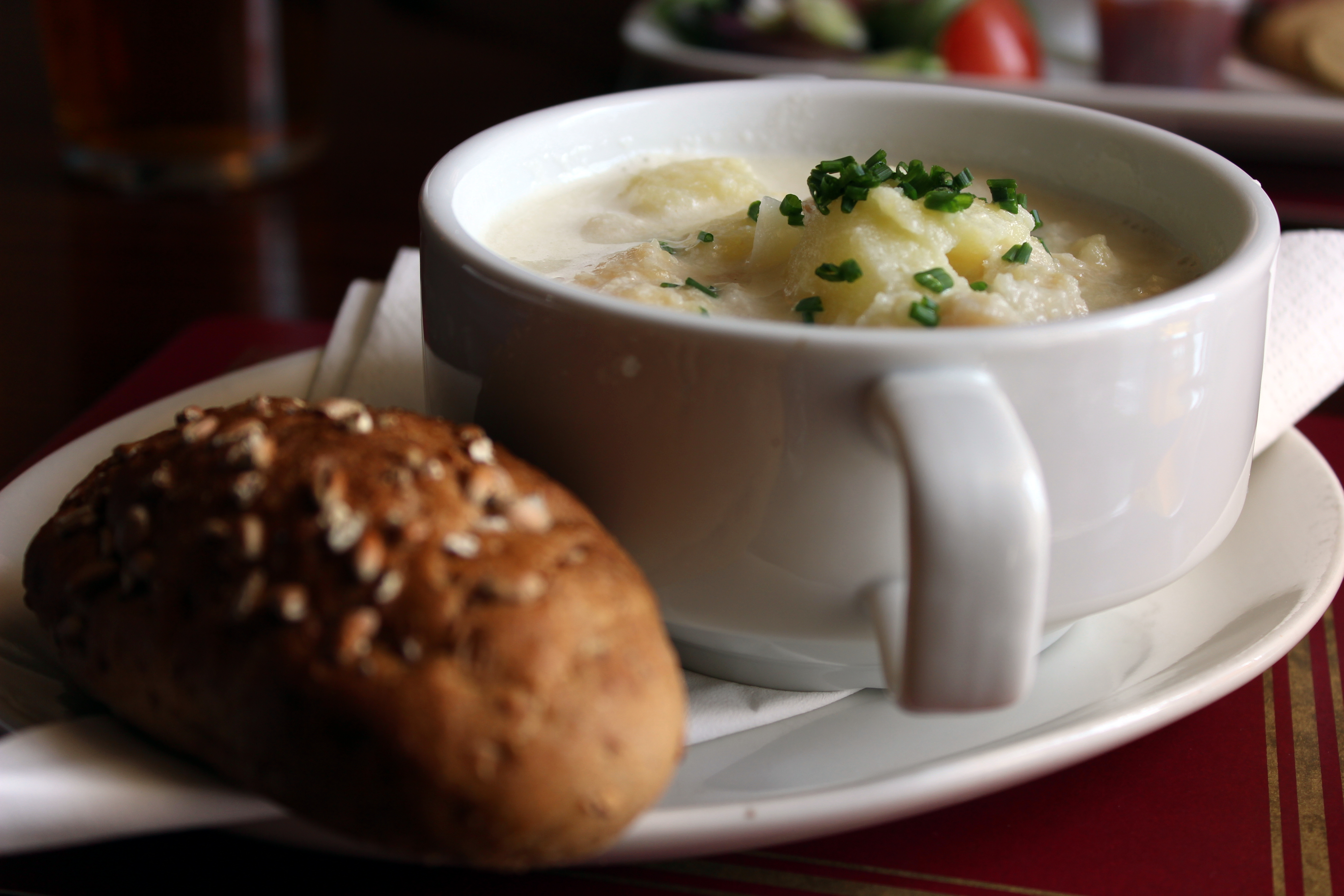
- Cover photograph: Cullen Skink by Metukkalihis, via Wikimedia Commons, licensed CC BY-SA 3.0. Original photograph, unchanged; shows a serving of the dish.