
Cobb Salad: Cut for the Toss
Cobb salad
The tidy stripes are a way to introduce the ingredients. The useful work happens earlier, at the cutting board, and later, when the dressing reaches the greens.
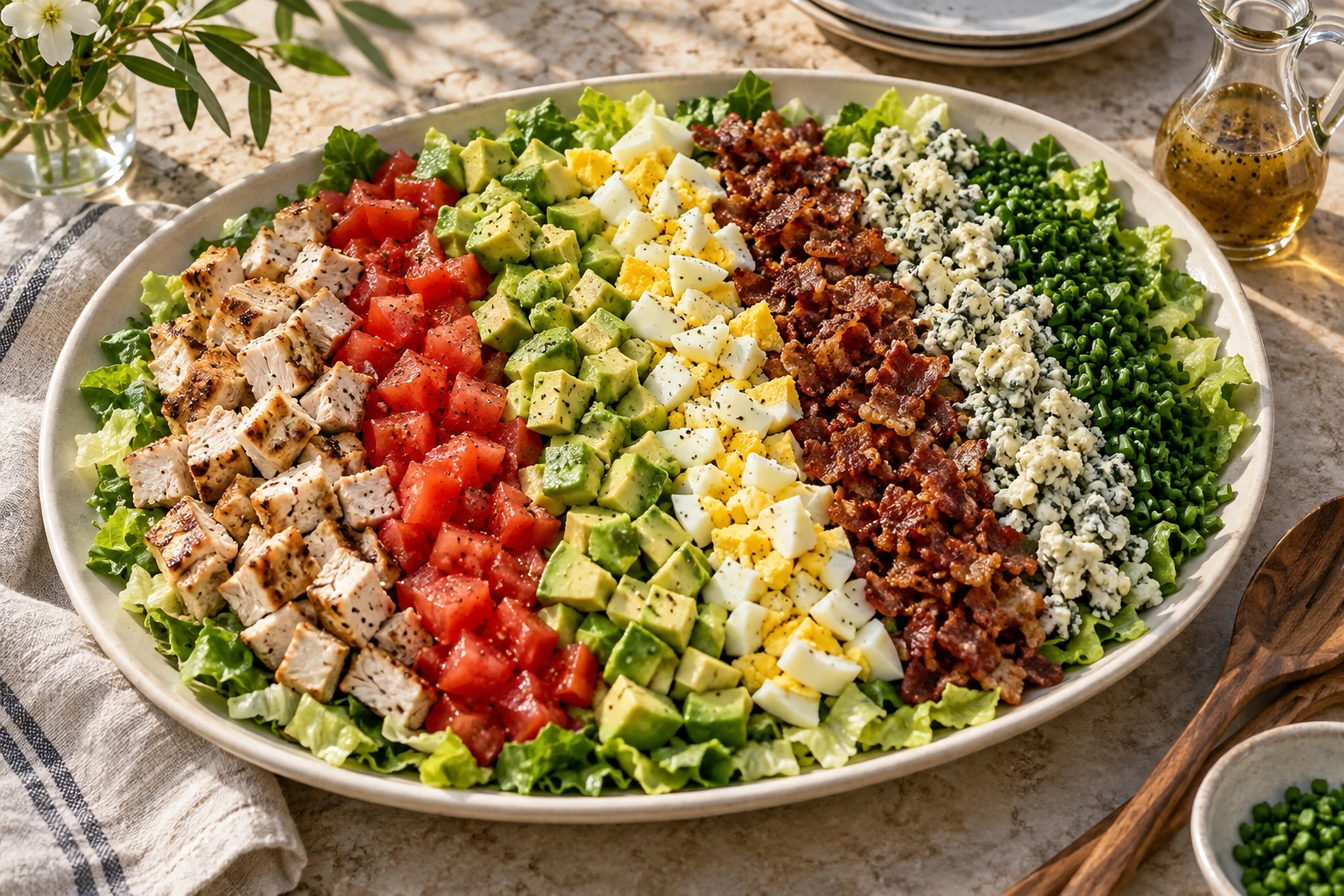
A Hollywood salad with a practical structure
Cobb salad has a strong association with Los Angeles's Brown Derby and its owner, Robert Cobb. Los Angeles magazine retells the late-night kitchen improvisation story; other accounts give different details. That makes an evocative restaurant legend, but the plate needs no precise invention date to explain its appeal.
Cold chicken, crisp bacon, hard-boiled egg, tomato, avocado and blue cheese make a substantial topping for chopped greens. The bright bands are immediately recognizable. Their geometry matters less than the ability to gather several ingredients without fighting a huge lettuce leaf or a slab of chicken.
Make the pieces agree
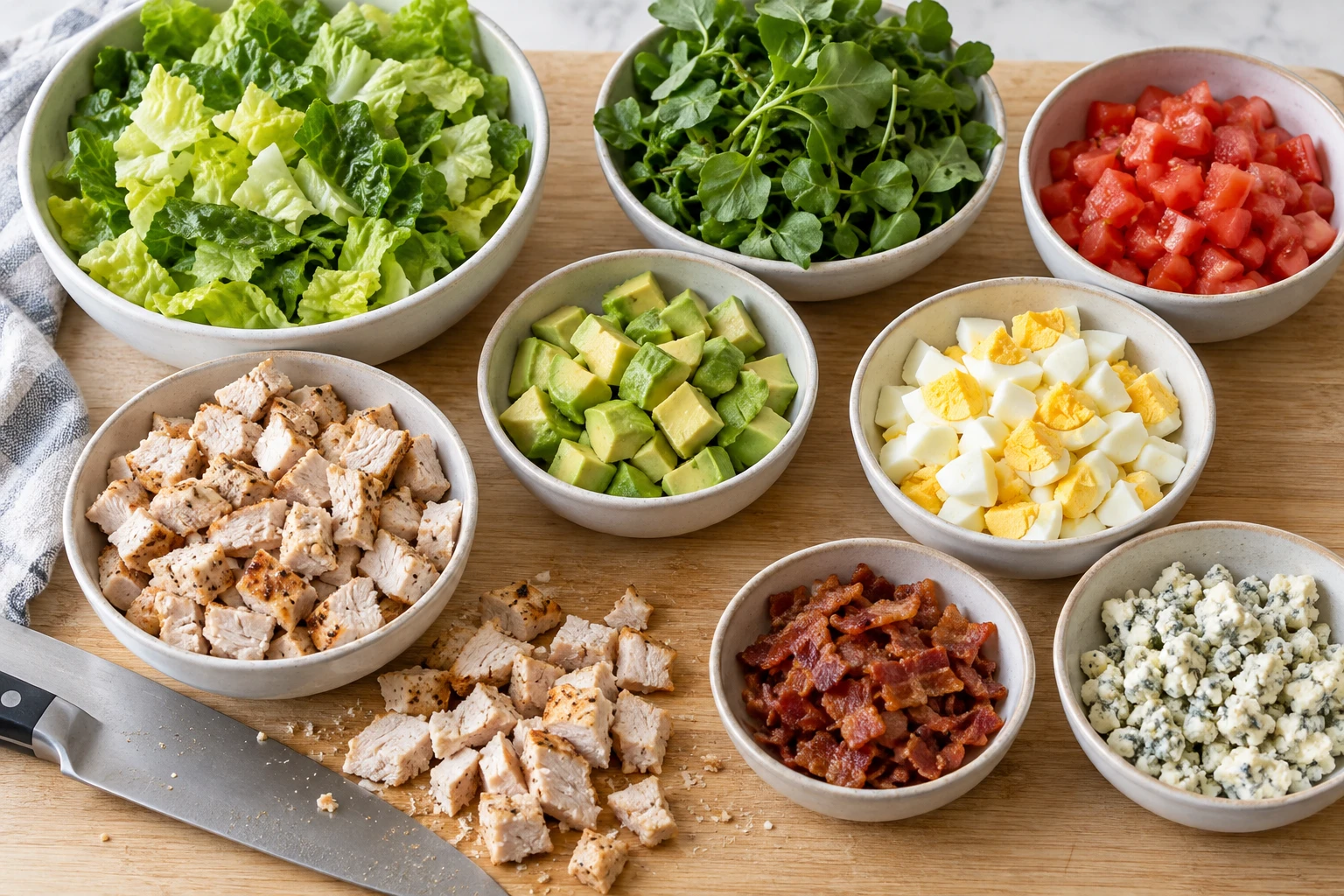
Saveur's version, adapted from The Los Angeles Times California Cookbook, gives several substantial components the same half-inch dice. That is a useful starting point for thinking about a Cobb: chicken should share a forkful with avocado and tomato, while bacon and cheese can scatter through the smaller gaps.
Uniformity does not require turning everything into mince. Keep enough body in the soft ingredients to distinguish them. A salad of intact pieces gives you both the separate flavors and the combined bite; a paste of avocado and yolk loses that contrast.
Prepare first, assemble late
Hallmark's own adaptation uses individually plated groups and delays both the avocado cutting and the final dressing. Its sequence offers a sensible way to organize the work.
- 01
Separate the jobs
Have the cooked chicken, hard-cooked eggs and crisp bacon ready before arranging the salad. Keep greens and toppings in separate containers while you work. This lets you check the cuts without dismantling a finished platter.
- 02
Leave the avocado until assembly
Cut it when the other components are ready. Hallmark specifically makes this the exception to its advance preparation advice. The point is to reserve one small, quick job for the last stage rather than complete the entire plate early.
- 03
Give the greens room
Use a broad plate or shallow bowl with a generous bed of chopped greens. Place toppings in groups that can be reached with the serving utensils, then add dressing just before the salad goes to the table.
Two adaptations, two different priorities
A winter version
Good Food's winter Cobb uses leftover roast chicken, Little Gem lettuce and celery, with crumbled blue cheese and halved hard-boiled eggs. Its dressing brings white wine vinegar, Dijon and honey together with spring onions. There is no tomato or avocado in that ingredient list: it is a seasonal adaptation, not a claim that those components never belong.
A looser modern platter
Mikel López Iturriaga's El Comidista version omits cheese and favors irregular pieces over strict rows. It keeps chicken, bacon, egg and avocado with a mustard vinaigrette. Its relaxed presentation demonstrates that the salad can remain recognizable without a striped arrangement.
Read where the cheese goes
Elise Bauer's Simply Recipes version puts Roquefort into the red wine vinaigrette rather than keeping it solely as a topping. She offers the dressing separately or tossed through the salad. Those choices change the bite: cheese in the dressing reaches the leaves, while visible crumbles give more concentrated pockets. Check the method before adding an extra handful of cheese.
Rows are a presentation, not an obligation
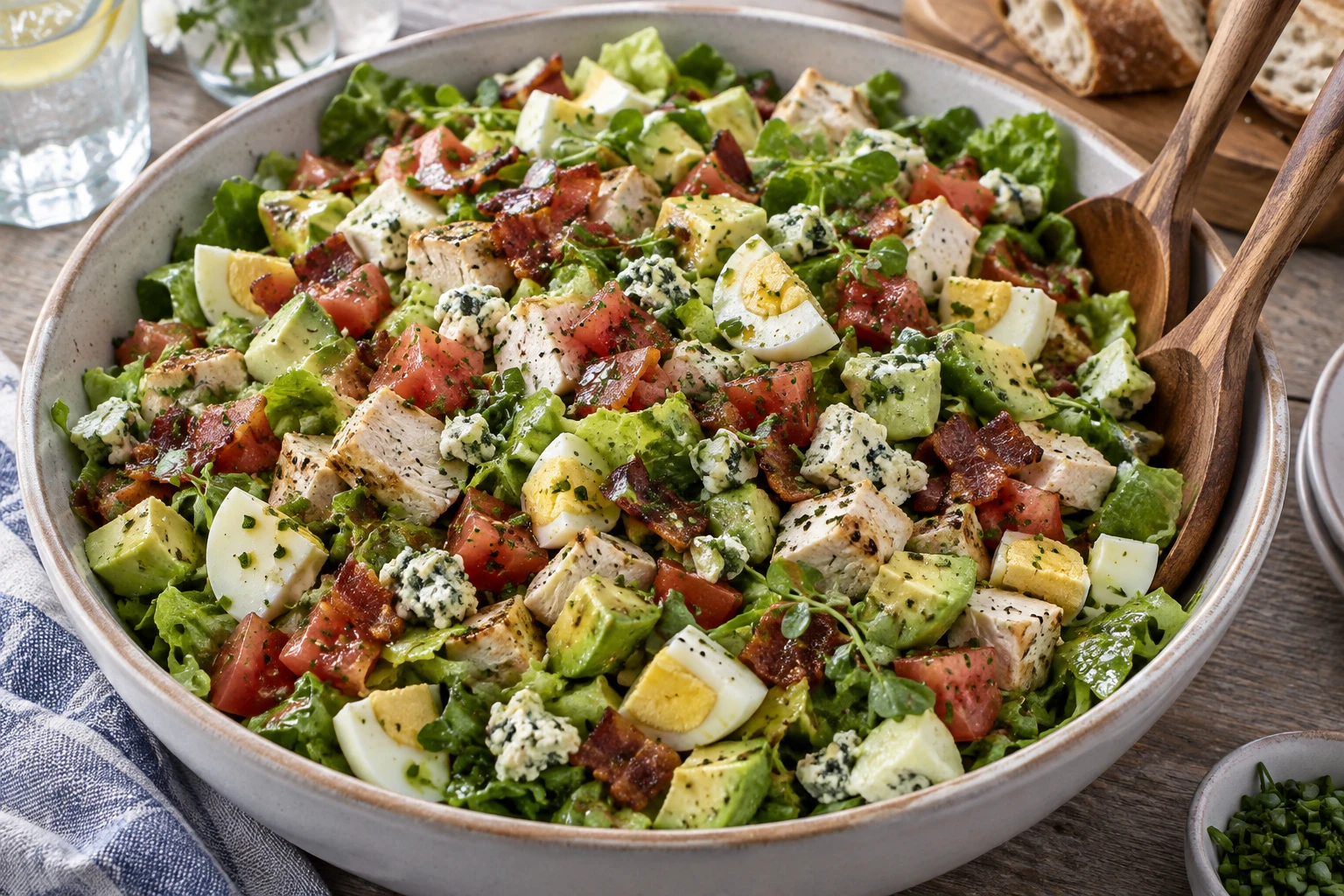
Saveur explicitly offers both a platter arranged in rows and a bowl with everything tossed together. Choose the platter when you want guests to see the components; choose the mixed bowl when you want the serving spoon to carry a little of each.
If you present rows, provide enough space and suitable utensils to mix or serve across them. A narrow scoop along a single band defeats the point of a composed salad. The useful finishing question is whether someone can comfortably gather greens, something creamy and something crisp in one bite.
Research notes
Sources
Historical context and distinct published approaches to cutting, dressing and arranging Cobb salad.
- Los Angeles magazine: Cobb salad Brown Derby association and the restaurant legend, treated as an account.
- Saveur: Cobb salad Cookbook-based adaptation with compatible dice and two serving arrangements.
- Elise Bauer: Cobb salad Roquefort in the vinaigrette; separate or tossed dressing.
- Good Food: Winter Cobb salad A distinct leftover-chicken, celery and Little Gem adaptation.
- El Comidista: Cobb salad An explicitly cheese-free adaptation with irregular cuts.
- Hallmark: Classic Cobb salad Independent adaptation with avocado cut late and dressing added at serving.
Keep exploring
More stories for your table
Hungarian cuisine Curd-cheese pasta
Túrós Csusza: Crisp Pasta, Soft Curds
How broad pasta, loose curd cheese, sour cream and crisp bacon work together in Hungarian túrós csusza, with two documented ways to finish the dish.
German cuisine Swabian stuffed pasta
Maultaschen: One Swabian Pocket, Three Ways to Serve It
Thin pasta and a savory filling make Maultaschen recognizable, but broth, browned onions and pan service change the meal. Explore the Swabian dish’s family variations and the limits of its monastery legend.
Argentinian cuisine Vegetable salad
Ensalada Criolla: Let the Pieces Share a Fork
Make a lightly dressed Argentine ensalada criolla with matched vegetable pieces, and understand how it differs from finer salsa criolla preparations.