
Pad Pak Ruam: Cut, Sort, Then Stir-Fry
Pad pak ruam
How do you cook a mixed pan without leaving the carrot hard or the cabbage limp? Start before the heat: cut the dense vegetables small, sort the pieces by cooking speed, and give the first group a little water and time.
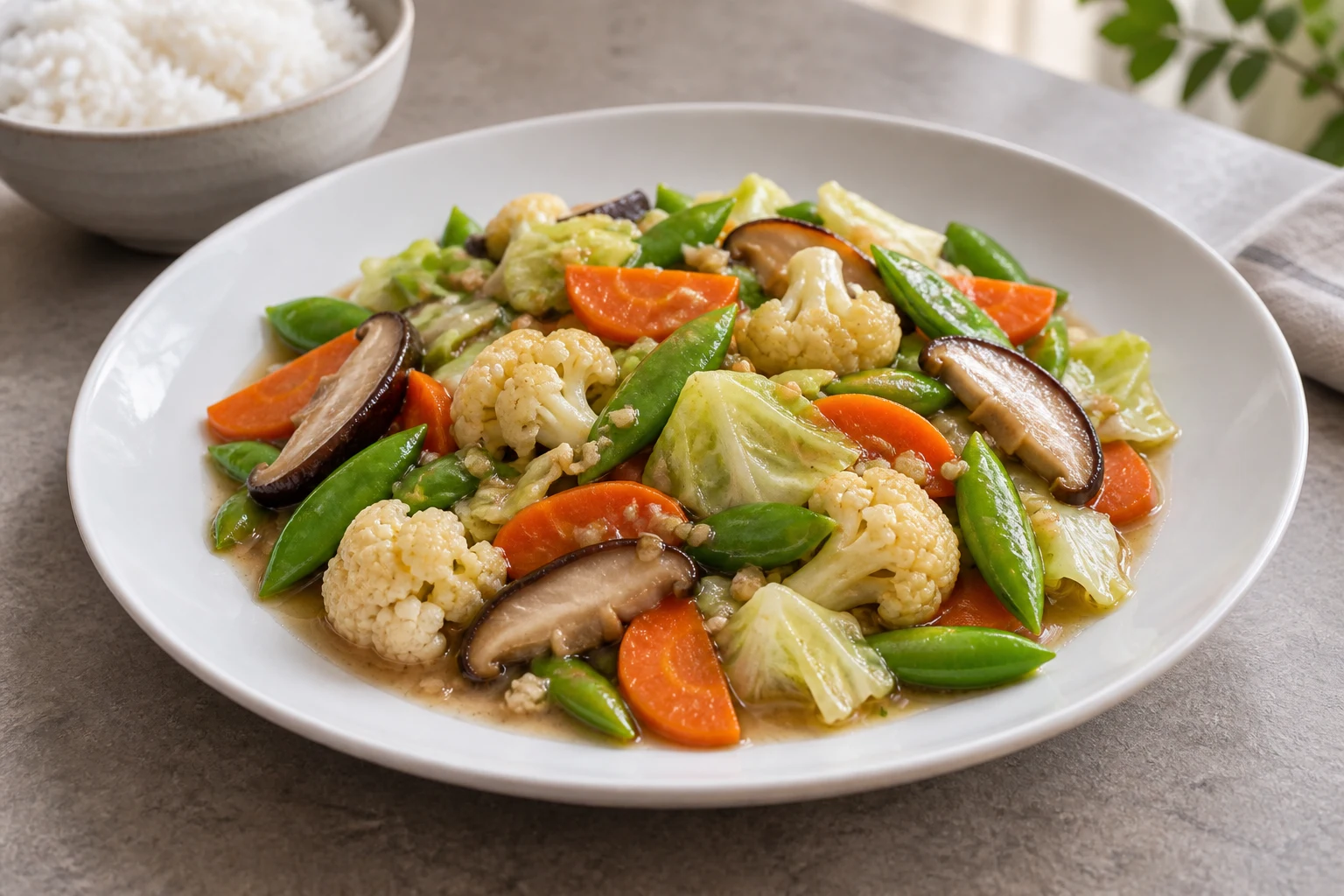
Pad pak ruam
A mixed dish needs an ordered pan
Pad pak ruam means stir-fried mixed vegetables: pad is stir-fry, pak vegetables and ruam mixed, as Pailin Chongchitnant explains at Hot Thai Kitchen. Her preparation and Praew’s Hungry in Thailand recipe place it comfortably alongside other dishes in a Thai family meal. The vegetable selection is flexible; the cooking order needs more thought.
The useful agreement across these cooks is to add vegetables in stages. Suwanee starts with firmer pieces, while Rachel Cooks Thai adds water by the tablespoon to help vegetables cook. Those are practical choices for the home stove. Our five-vegetable version uses two groups and a premixed sauce, so the important decisions are made before the garlic hits the oil.
Three controls for a mixed stir-fry
- 01
Cut for cooking speed.
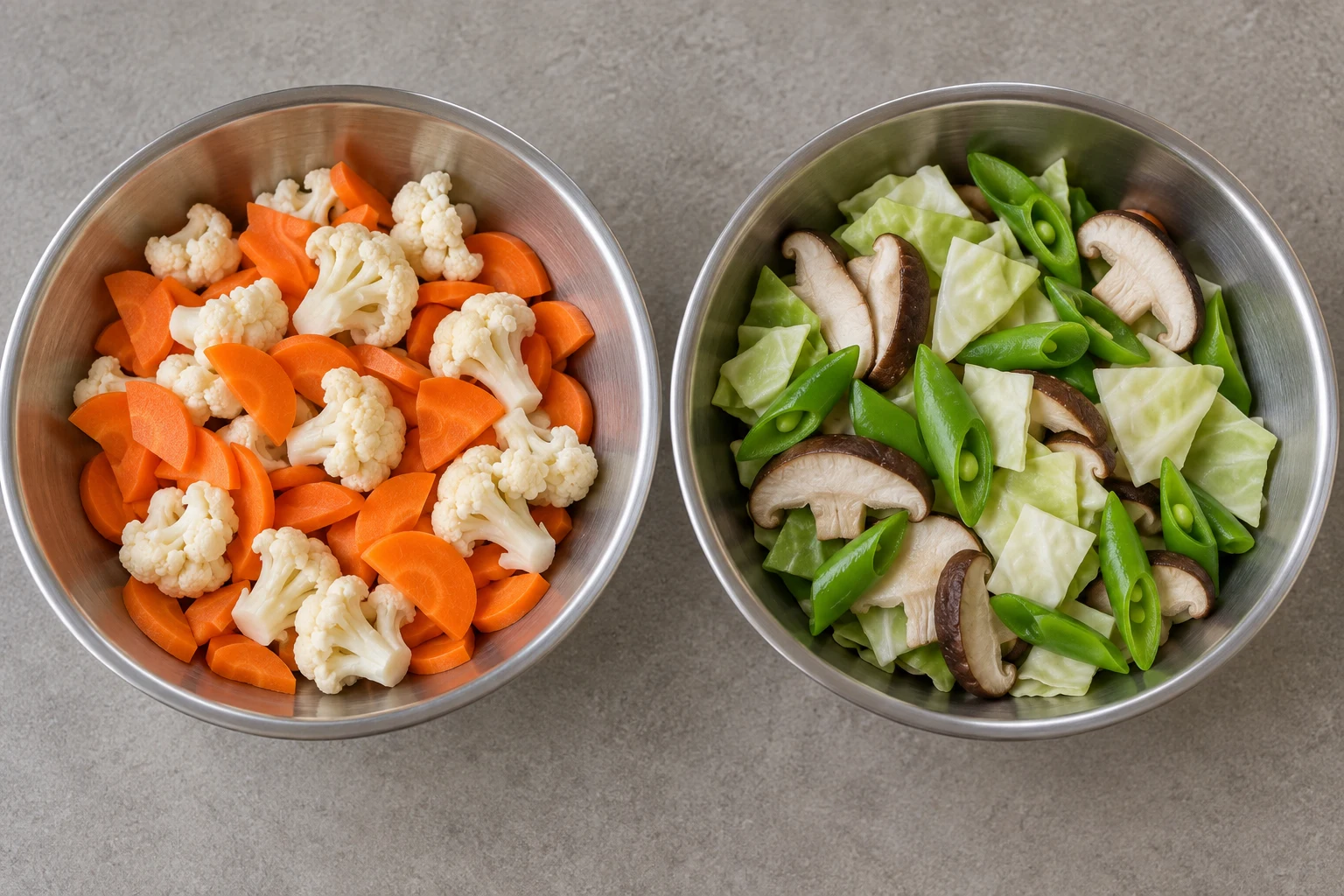
A thick carrot chunk and a thin cabbage leaf will not finish together. Chongchitnant cuts firm vegetables small and separates them from faster-cooking ones; leafy greens get their own final stage. Here, thin carrot slices and small cauliflower florets form the first group.
- 02
Use water deliberately.
Rachel’s tablespoon-at-a-time method gives firm vegetables help without flooding the pan. Start with a little and add more only when needed. Praew also warns against overcrowding: a heap of vegetables makes it harder to manage their texture. Keep the recipe quantity within a roomy pan.
- 03
Have the seasoning ready.
Suwanee mixes the sauce before cooking and recommends unsalted stock when using stock. Our adaptation uses water, leaving oyster sauce and light soy sauce to provide the salt. Premixing means less time measuring over vegetables that are already cooking.
Preparation sets the sequence
A five-vegetable home adaptation
Pad pak ruam with carrot, cauliflower and snap peas
Makes 4 side servings in about 30 minutes: 20 minutes preparation and 10 minutes cooking. This untested home adaptation draws on the staged methods in the sources below. Use a roomy wok or a deep frying pan about 30 cm across. Vegetable weights are after trimming; rice, if served alongside, is prepared separately.
Ingredients
Vegetables and aromatics
- 100 g carrot, peeled
- 150 g cauliflower florets
- 150 g green cabbage
- 100 g fresh shiitake caps, tough stems removed
- 100 g sugar snap peas, strings removed
- 4 cloves garlic, finely chopped
- 30 ml / 2 tbsp neutral vegetable oil
Sauce and cooking liquid
- 30 ml / 2 tbsp oyster sauce
- 15 ml / 1 tbsp light soy sauce, preferably Thai; not dark soy sauce
- 1 tsp sugar
- Up to 60 ml / 4 tbsp water, divided: 15 ml for the sauce and up to 45 ml for the pan
Method
- 1
Cut and sort.
Wash the vegetables and drain well. Halve the carrot lengthways and slice into half-moons 2–3 mm thick. Cut the cauliflower into small florets about 2 cm across, slicing any thick stem pieces thinly. Put these together in one bowl. Cut the cabbage into roughly 3 cm pieces, slice the mushroom caps about 5 mm thick, and halve the snap peas diagonally. Put these three vegetables in a second bowl.
- 2
Prepare the sauce.
Stir the oyster sauce, light soy sauce, sugar and 15 ml water together in a small bowl. Keep the remaining 45 ml water beside the stove; you may not need it all.
- 3
Start the firm vegetables.
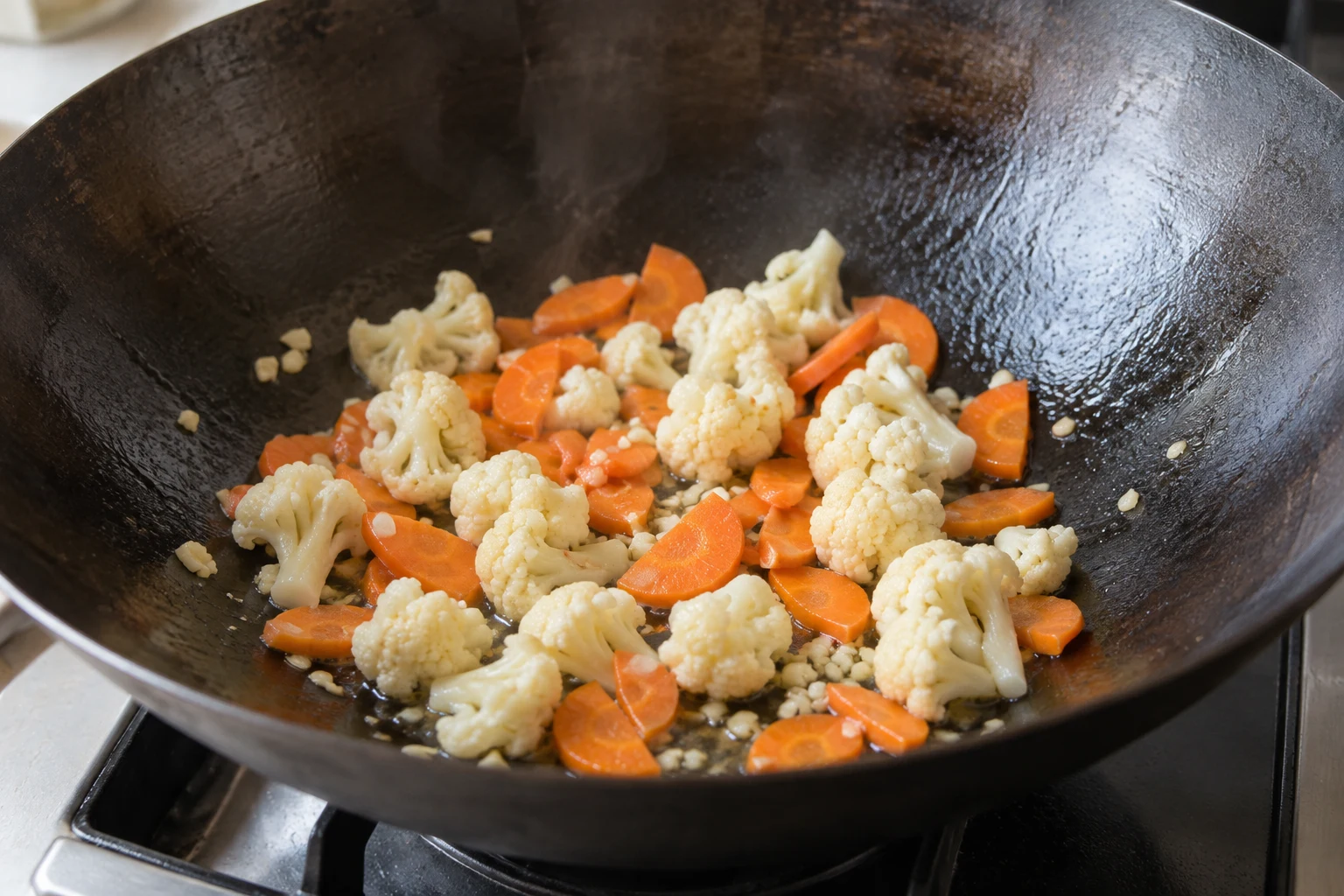
Heat the oil in the wok over medium-high heat. Add the garlic and stir for about 20 seconds, until fragrant. Add the carrot and cauliflower, then carefully pour in 15 ml of the reserved water. Stir-fry for about 3 minutes, adding another 15 ml water if the pan dries before the vegetables begin to soften. A small knife should enter a cauliflower stem with some resistance before you continue.
- 4
Add the second group.
Add the cabbage, mushrooms and snap peas. Toss for 1 minute, then add all the sauce. Stir-fry for another 2–3 minutes, until the cauliflower and mushrooms are tender, the cabbage has softened and the snap peas still have bite. If the pan catches, add any remaining reserved water a little at a time. If the vegetables need longer, keep tossing and check them again rather than stopping by the clock.
- 5
Serve while the textures differ.
Transfer to a serving plate as soon as the vegetables are ready, spooning over the sauce from the pan. Serve promptly as a side dish. Rice is one simple accompaniment.
Research notes
Sources and adaptation notes
Four independently authored preparations inform the method. The weights, two-group arrangement and shortened sauce list above are an editorial adaptation, not a claim that every Thai household uses this mix.
- Pailin Chongchitnant — Thai Mixed Veg Stir-Fry Explains the name, vegetable flexibility, cut sizes and staged additions, including a separate finish for leafy greens.
- Praew — Thai Vegetables Stir Fry (Pad Pak Ruam Mit) Thai family-meal context, cooking firmer vegetables first, pan crowding and a mushroom-sauce option.
- Suwanee — Thai Mixed Vegetable Stir Fry A premixed sauce, ordered additions and advice to use unsalted stock when adding stock.
- Rachel Cooks Thai — Stir Fried Mixed Vegetables A different vegetable selection with shrimp; used here for staged vegetables and measured water, not for its shrimp preparation.
Keep exploring
More stories for your table

ThailandPork braise
Moo Hong: Tender Pork Before a Rich Sauce
Phuket’s soy-braised pork rewards a patient simmer. Learn how to manage the liquid, understand its spice variations and cook a pepper-focused home adaptation.

IndonesiaVegetable sides
Plecing Kangkung: Greens First, Sambal Last
Cook the stems before the leaves, drain thoroughly, then add coarse tomato sambal. A guide to Lombok’s plecing kangkung, with a peanut-topped home adaptation.
JamaicaJerk burger
Jamaican Jerk Burger: Start with the Seasoning
Choose the right jerk seasoning for a beef burger, then make four skillet burgers with crisp cabbage slaw. A practical adaptation grounded in Jamaican flavours.