
Halawet el Jibn: When Cheese Becomes the Wrapper
حلاوة الجبن
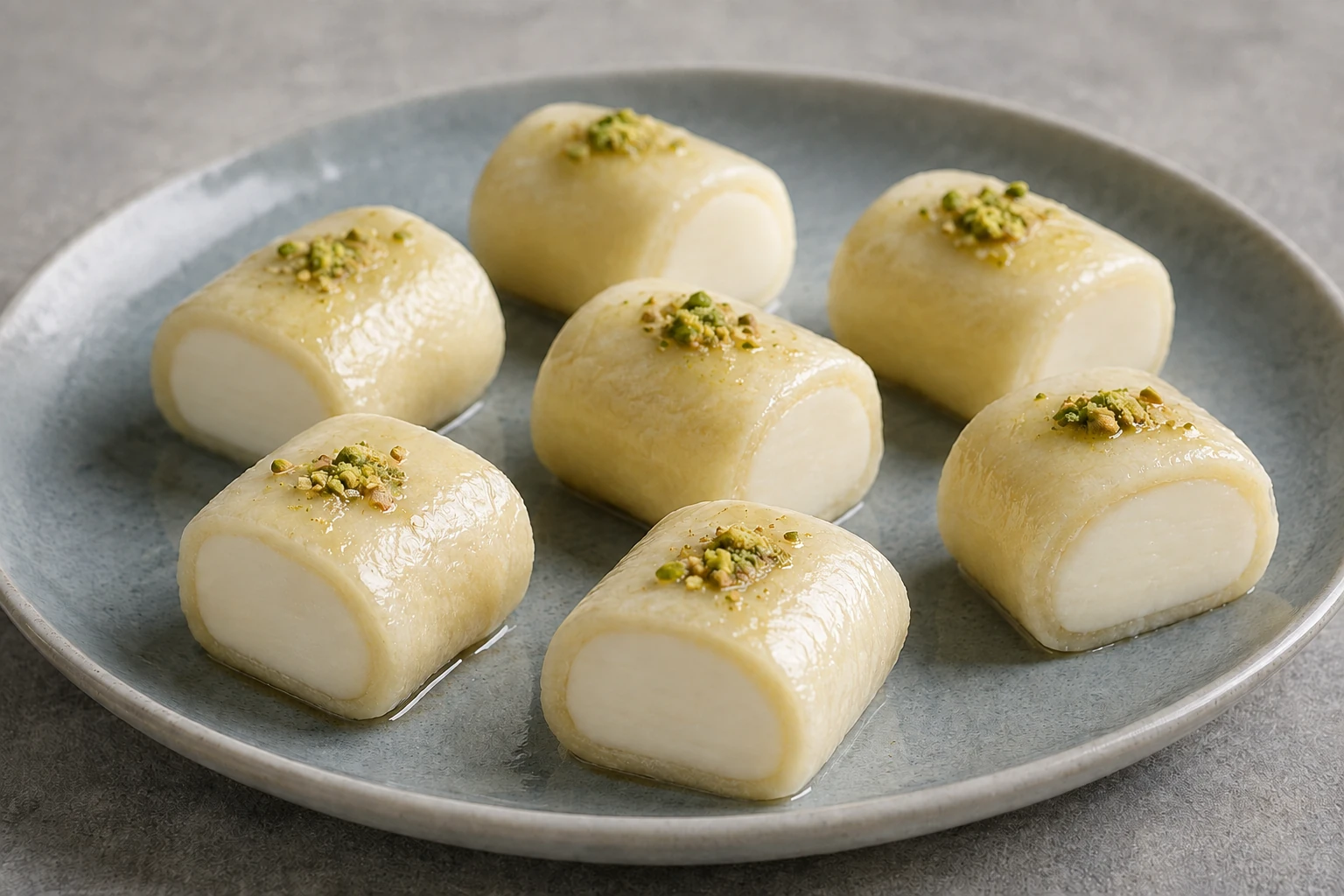
In halawet el jibn, cheese and fine semolina become a soft sheet that folds around cream. Tripoli’s sweet shops offer another way to enjoy it, too: torn into pieces, with the cream spread on top. Understanding the sheet makes both forms easier to read—and the rolls easier to prepare.
Tripoli and the wider Levant
The wrapper is part of the sweet
Cut into a roll of halawet el jibn and you meet two different dairy preparations. The ivory outside is cooked cheese-and-semolina dough. Inside is ashta, also written kashta or kachta, a thick milk cream. Syrup and pistachios finish the sweet; the contrast begins with that supple sheet around the softer center.
Rita Sassine’s 2012 report for L’Orient-Le Jour follows its preparation at Abdel Rahman Hallab’s pastry business in Tripoli, northern Lebanon. The reported method begins with unsalted fresh cow’s cheese and describes working the dough before it cools, then stretching it into a fine sheet. Lebanese cookbook author Hadia Zebib also documents the dessert in Lebanese sweet shops and in her family’s cooking.
Halawet el jibn carries Syrian traditions as well. In an oral-history interview hosted by the University of Sussex, Noor Abdulrazzaq recalls the rivalry between Hama and Homs over its origin. Her claim for Hama is a participant’s account of that debate. Tripoli’s documented practice gives us a specific place to examine how the sweet is made and served.
Set up for a pliable sheet
- 01
Choose the cheese deliberately
Hadia Zebib and Cleobuttera describe mozzarella as a home substitute for cheeses such as Akkawi, which may need desalting. For the adaptation below, use low-moisture block mozzarella. Cleobuttera specifically cautions that water-packed fresh mozzarella changes the dough’s moisture balance.
- 02
Know which cream you are making
Traditional ashta is collected from the surface of heated milk. The milk, cream and cornstarch filling below is a home shortcut, similar to a thick pudding. It needs to be completely cold before assembly.
- 03
Prepare cold components first
Make the filling and syrup before the dough. Hadia recommends this order, while Tania Bakes uses syrup to help spread the sheet. Have the parchment and filling ready so the warm dough can be rolled without a long pause.
A small home batch
Halawet el jibn with mozzarella and ashta-style cream
This home adaptation makes about 18 short rolls, or 9 servings of two. It uses mozzarella and a starch-thickened cream filling, drawing on the home methods below. Allow about 2 hours 20 minutes, including cooling and chilling. A scale, saucepan, spatula, parchment and rolling pin are useful; a piping bag is optional.
Ingredients
Ashta-style filling
- 240 ml whole milk, pasteurized
- 80 ml heavy cream, pasteurized
- 20 g cornstarch
Floral syrup
- 200 g granulated sugar
- 120 ml water
- 5 ml (1 tsp) lemon juice
- 5 ml (1 tsp) orange blossom water
- 2.5 ml (½ tsp) rose water
Cheese-semolina sheet
- 180 ml water
- 75 g granulated sugar
- 80 g fine semolina
- 120 g low-moisture whole-milk mozzarella made with vegetarian rennet, grated from a block
- 7.5 ml (1½ tsp) orange blossom water
- 7.5 ml (1½ tsp) rose water
To finish
- 20 g unsalted shelled pistachios, finely crushed
Method
- 1
Cook and chill the filling
Whisk the milk, cream and cornstarch together in a cold saucepan. Heat while whisking until thick and bubbling throughout; cook for another 30 seconds. Spread in a shallow container, cover the surface with parchment and refrigerate promptly. Allow at least 1 hour, until cold and firmly set. Stir smooth before filling.
- 2
Prepare the syrup
While the filling chills, dissolve the syrup sugar in its 120 ml water with the lemon juice. Bring to a boil, then simmer gently for 7 minutes. Remove from the heat and add the syrup’s orange blossom and rose waters. Cool. Reserve 15 ml (1 tablespoon) for the parchment; keep the rest for serving.
- 3
Cook the sheet
Once the filling is cold, heat the dough’s 180 ml water and 75 g sugar until dissolved and simmering. Stir in the fine semolina; cook, stirring, until it thickens, about 1–2 minutes. Lower the heat, add the mozzarella and stir until melted into a smooth, cohesive mass, about 2–4 minutes. Stir in both dough flavorings. Let it become comfortably warm to handle.
- 4
Roll and divide
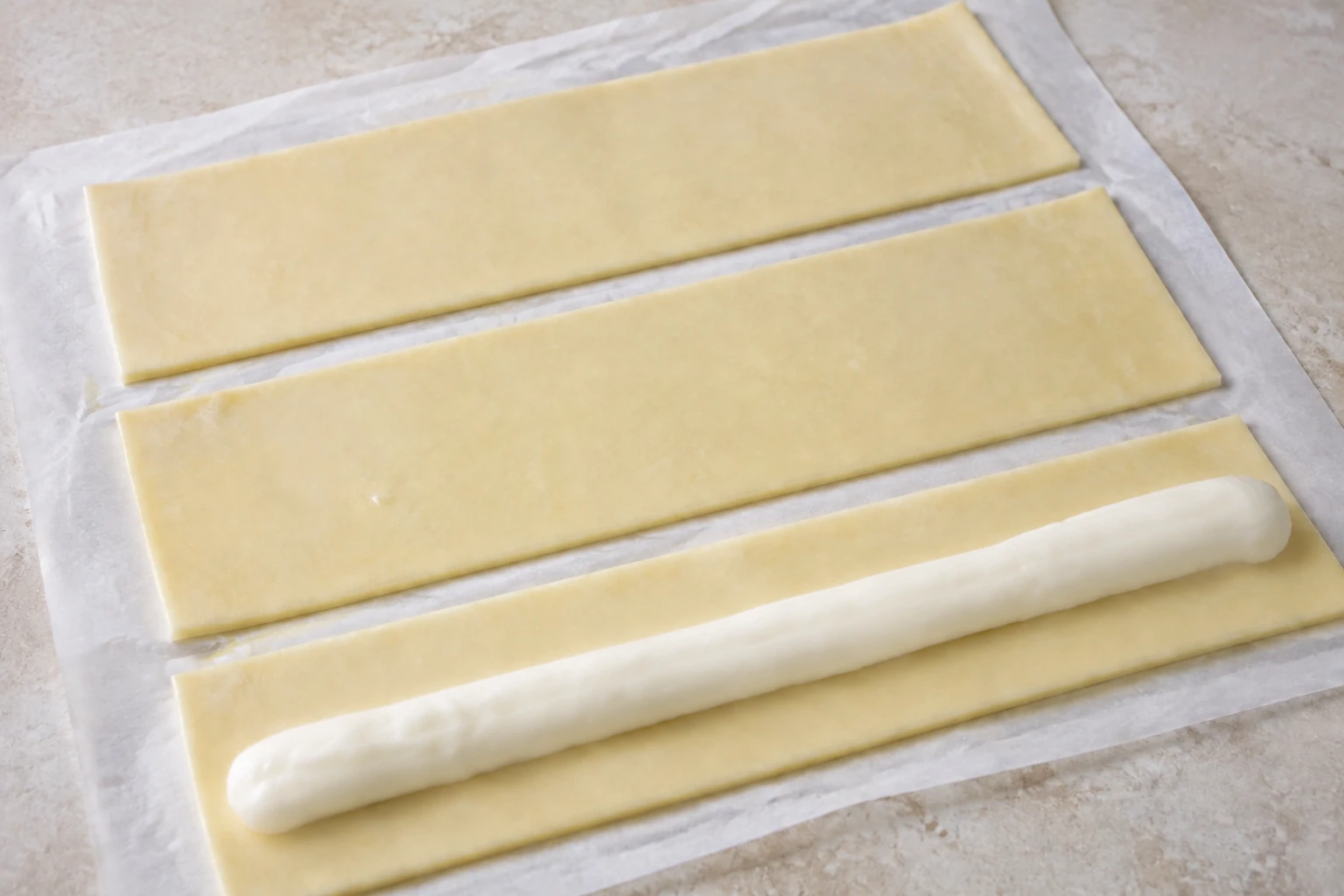
Lightly coat two parchment sheets with the reserved tablespoon of syrup. Roll the warm dough between them to a roughly 30 cm square, about 4–5 mm thick. Remove the top paper and trim only ragged edges. Cut into three strips about 30 by 10 cm. Keep the strips covered when not working with them.
- 5
Enclose the cream
Divide all the cold filling into three equal portions. Pipe or spoon one portion in a line along a long edge of each strip, leaving a small border. Lift the parchment to fold the dough around the cream, overlapping the edges to close the seam. Set the three logs seam-side down, cover and refrigerate for 30 minutes.
- 6
Cut and serve
Cut each log into six roughly 5 cm pieces. Sprinkle with the pistachios and offer the remaining syrup separately. Refrigerate the rolls until serving; they are best enjoyed the day they are made. Keep dairy desserts at or below 4°C (40°F). Discard portions left out longer than 2 hours, or 1 hour above 32°C (90°F), following FDA guidance.
The sheet also stands on its own
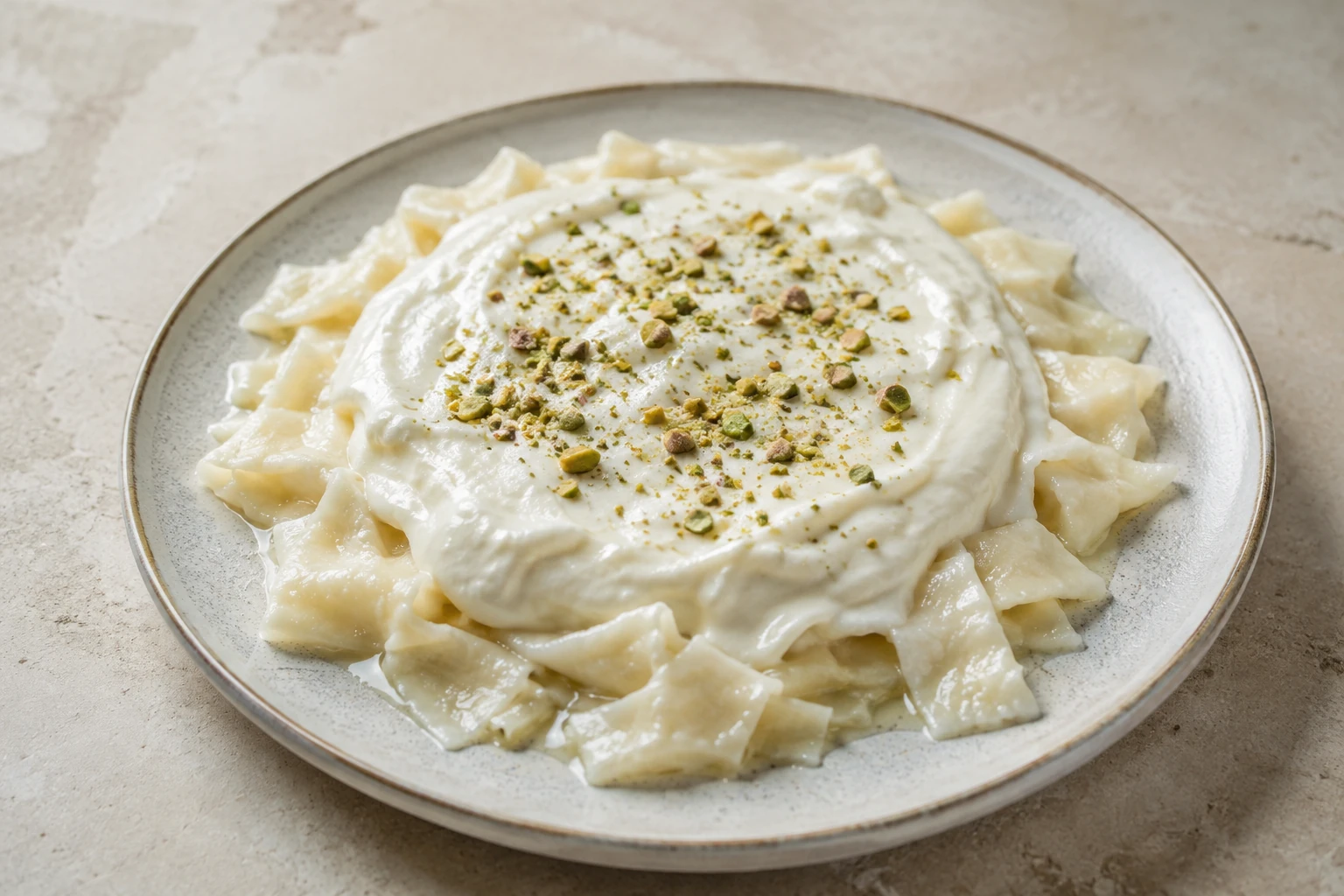
The Tripoli report describes two presentations: squares wrapped around kachta, and dough torn into pieces, arranged on a plate and covered with cream. Both receive pistachios and sugar syrup. The loose presentation makes the sheet itself more visible: it is a finished component of the dessert, with a place on the plate beyond its job as a wrapper.
Research notes
Sources and recipe notes
Local reporting establishes the Tripoli practice. The home recipe adapts documented mozzarella methods and distinguishes its cream shortcut from traditional ashta; storage guidance follows the FDA.
- Rita Sassine, L’Orient-Le Jour — La halewet el-jeben, reine tripolitaine September 5, 2012 reporting from Tripoli describes the cheese-semolina sheet, warm working and both filled and torn presentations.
- Hadia Zebib — Halawet Al Jibn Lebanese family and sweet-shop context, cheese substitution, starch-thickened filling, make-ahead planning and parchment rolling.
- Tania Bakes — Halawet El-Jibn An independent Lebanese home version using mozzarella and fine semolina, syrup-assisted spreading, cream filling and floral syrup.
- Cleobuttera — Halawet El Jibn Semolina-first mozzarella dough and roll assembly; the author’s replies clarify block versus water-packed mozzarella. Our smaller batch and portion sizes are adaptations.
- Cleobuttera — Easy Homemade Ashta Cream Explains the difference between traditionally collected milk cream and a thickened home shortcut, including chilling before use.
- Agricultural Voices, University of Sussex — Noor’s Story Noor Abdulrazzaq’s oral-history interview records the Hama–Homs origin rivalry; cited as personal testimony, not a settled origin finding.
- FDA — Are You Storing Food Safely? Current refrigerator-temperature guidance and the two-hour limit for perishable food, reduced to one hour above 90°F.
Keep exploring
More stories for your table
LebanonGathering table
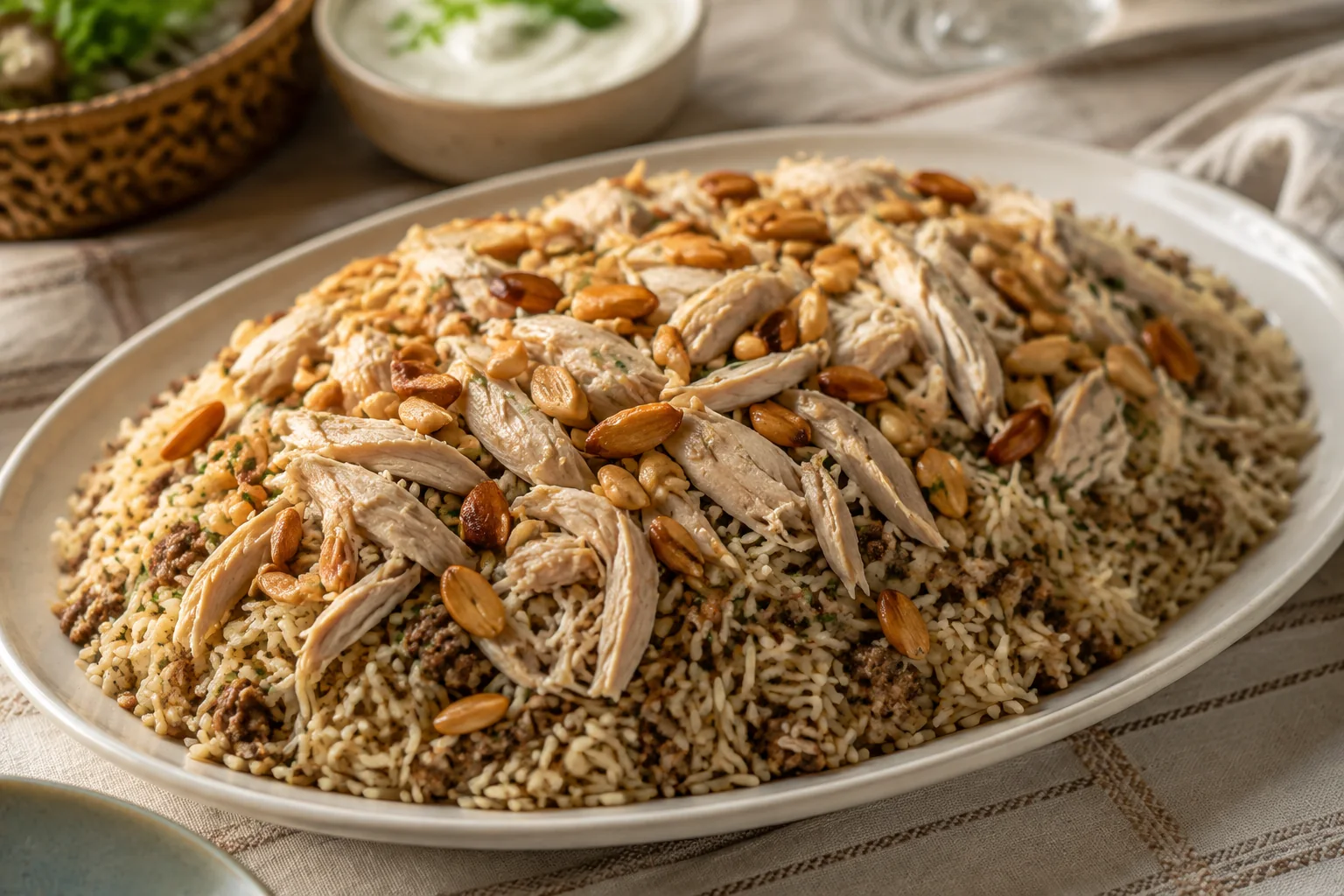
Riz bi Djej
Fragrant rice and finely browned meat, crowned with tender chicken and a generous scatter of toasted nuts.
BelgiumChocolate confectionery
Belgian Chocolate Truffles, Beneath the Cocoa
Look beneath the cocoa on Belgian chocolate truffles: compare buttercream and ganache centers, decode the shell and finish, and understand the Belgian origin label.

SpainSweet fritters
Buñuelos de Viento: How Spain’s Airy Fritters Rise
Why buñuelos de viento puff, when to serve them plain or filled, and how to make a small batch of Spain’s airy lemon fritters at home.