


Summary:
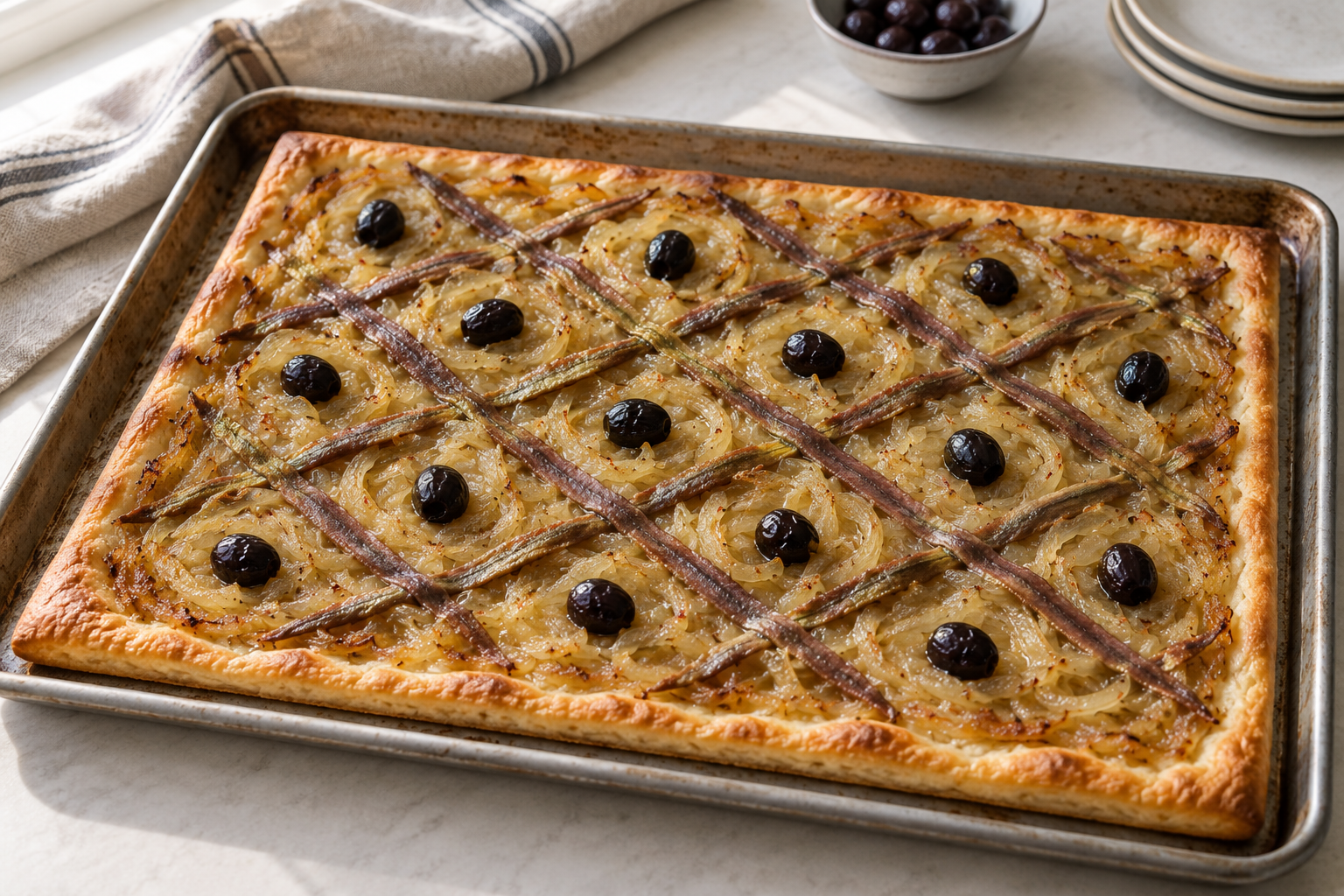
Cook the onions until tender before topping the dough, then bake for a firm golden base beneath anchovies and olives.Pissaladière puts onions in charge. On this Niçois savoury tart, the bread base supports a generous layer of softened onions, with anchovies and black olives supplying concentrated salty bites. There is no tomato sauce or cheese to hide an undercooked topping.
A tart with a sense of place
Nice’s tourism office presents pissaladière as a local appetiser built from bread dough, onions, anchovies and olives. Its method favours gently cooked onions without strong browning. The France.fr recipe taught by Nice-based cookery teacher Rosa Jackson allows a little caramelisation. Those approaches share a useful lesson: tenderness comes before colour. The home adaptation below uses a simple egg-free yeast dough and a lightly golden topping, rather than claiming to reproduce one definitive local formula.
Recipe at a glance
Yield: one 30 × 25 cm (12 × 10 inch) tart; 6 starter portions or 12 small squares. Prep: about 30 minutes. Cooking: 45–55 minutes for the onions plus 25–30 minutes baking. Rise: 60–90 minutes, overlapping the onion cooking. Total: approximately 2–2½ hours, including a 10-minute rest. Times are estimates; this recipe has not been kitchen-tested.
Equipment: kitchen scale, bowl, broad heavy frying pan with lid, rolling pin, baking tray and baking parchment. Contains wheat and fish.
Ingredients
Dough
- 250 g (about 2 cups, spooned and levelled) all-purpose flour, plus up to 1 tablespoon for dusting
- 4 g (1¼ teaspoons) instant yeast
- 4 g (⅔ teaspoon) fine salt
- 150 ml (½ cup plus 2 tablespoons) lukewarm water
- 15 ml (1 tablespoon) olive oil
Topping and tray
- 1 kg (2¼ lb) yellow onions, weighed after peeling, halved and thinly sliced
- 30 ml (2 tablespoons) olive oil, plus 5 ml (1 teaspoon) for the tray
- 2 garlic cloves, finely chopped
- 1 teaspoon fresh thyme leaves
- 1 bay leaf
- ¼ teaspoon freshly ground black pepper
- 40 g (about 12–16) drained oil-packed anchovy fillets
- 50 g (about ⅓ cup) small black olives, preferably Niçoise, pitted
- Up to 30 ml (2 tablespoons) water, only if needed to prevent the onions catching
Weights are the more reliable guide, especially for flour and onions. Anchovy size and saltiness vary. No extra salt is specified for the topping: taste it with a small piece of anchovy before deciding whether it needs any.
Method
- Make a supple dough. Mix the flour, instant yeast and salt in a bowl. Add the 150 ml water and tablespoon of oil; stir until no dry pockets remain. Knead for 7–9 minutes until smooth and elastic, using only enough of the dusting flour to prevent sticking. Cover the bowl and let rise in a comfortably warm place for 60–90 minutes, until roughly doubled. A cool kitchen will take longer.
- Soften, rather than scorch, the onions. While the dough rises, warm 2 tablespoons oil in a broad pan over medium-low heat. Add the onions and bay leaf. Cover and cook for 20 minutes, stirring every few minutes. Uncover, add the garlic and thyme, and continue cooking for 25–35 minutes. Reduce the heat if the edges darken quickly; add the optional water a tablespoon at a time if the pan catches.
- Check the topping before assembly. The onions should be limp and sweet-smelling, with no firm raw centres. Draw a spoon across the pan: there should be no puddle of watery liquid. If necessary, cook uncovered a little longer. Remove the bay leaf, stir in the pepper and spread the onions on a plate to cool until no longer hot. Do not put steaming onions on the dough.
- Shape the base. Heat the oven to 220°C / 425°F, conventional, with a rack in the lower third. Line a tray with parchment and brush it with the teaspoon of oil. Gently deflate the risen dough and roll or stretch it into a 30 × 25 cm rectangle, leaving a slightly thicker rim. If it springs back, cover and rest for 10 minutes before continuing; do not force it thin enough to tear.
- Top and bake. Spread the cooled onions evenly over the dough, leaving a narrow border. Arrange the anchovies in loose diagonal lines and distribute the pitted olives between them. Bake for 25–30 minutes, rotating the tray if one side colours faster. The edge should be golden and the underside firm and browned, not pale or doughy. Lift a corner with a spatula to check; tent the topping loosely with foil if it colours before the base is done.
- Rest and portion. Leave on the tray for 5 minutes, then move to a rack for another 5 minutes so trapped steam does not soften the bottom. Cut into 6 portions or 12 small squares. Serve warm; do not leave the fish-topped tart sitting out for an extended buffet.
Troubleshooting the two textures
Onions brown but stay crunchy: the heat is too high or the pan too crowded. Lower the heat, cover briefly and give them more time. Dark edges are not proof that the centre is tender.
Wet centre, crisp rim: drain nothing away blindly; first evaporate excess onion liquid in the pan. Also check that the dough was spread to an even thickness. A second tray underneath can slow bottom browning, so use a single tray unless the underside is already catching.
Too salty: distribute smaller anchovy pieces more evenly next time and choose less salty olives. Do not add sugar to conceal salt. A plain salad alongside offers contrast without changing the tart itself.
Serving, substitutions and make-ahead
Small Niçoise olives fit the regional character; another small black olive is a practical substitute with a different flavour. Pitting makes the squares easier to eat. Omitting anchovies produces an onion-and-olive tart, not the same fish-seasoned result; label that change clearly.
Cook the onion topping a day ahead, refrigerate promptly in a shallow covered container and use within 24 hours for this plan. Let it lose its refrigerator chill briefly while the dough is shaped, without exceeding safe room-temperature limits. For another French baking technique, read our guide to gougères; for a different Mediterranean bread-and-topping balance, see Cretan dakos.
Storage and reheating
Refrigerate leftover portions in shallow containers within 2 hours of cooking, or within 1 hour above 32°C / 90°F. Keep at 4°C / 40°F or below and eat within 3–4 days. Reheat in an oven until the centre reaches 74°C / 165°F; a thermometer is more reliable than a crisp-looking edge. Discard portions left out beyond those limits. These precautions also apply when packing the tart for a picnic.
Sources and image note
Culinary context: Nice Côte d’Azur Tourist Office, La Pissaladière; France.fr, Rosa Jackson’s Niçois recipe. The measured formula and explanatory prose here are an original home adaptation, not a tested reproduction. Food safety: University of Illinois Extension, leftovers and FoodSafety.gov, four steps to food safety.
Image: AI-generated serving illustration created for SmartRestro with OpenAI, October 2026. It illustrates the dish and is not a photograph of this recipe being tested.


