


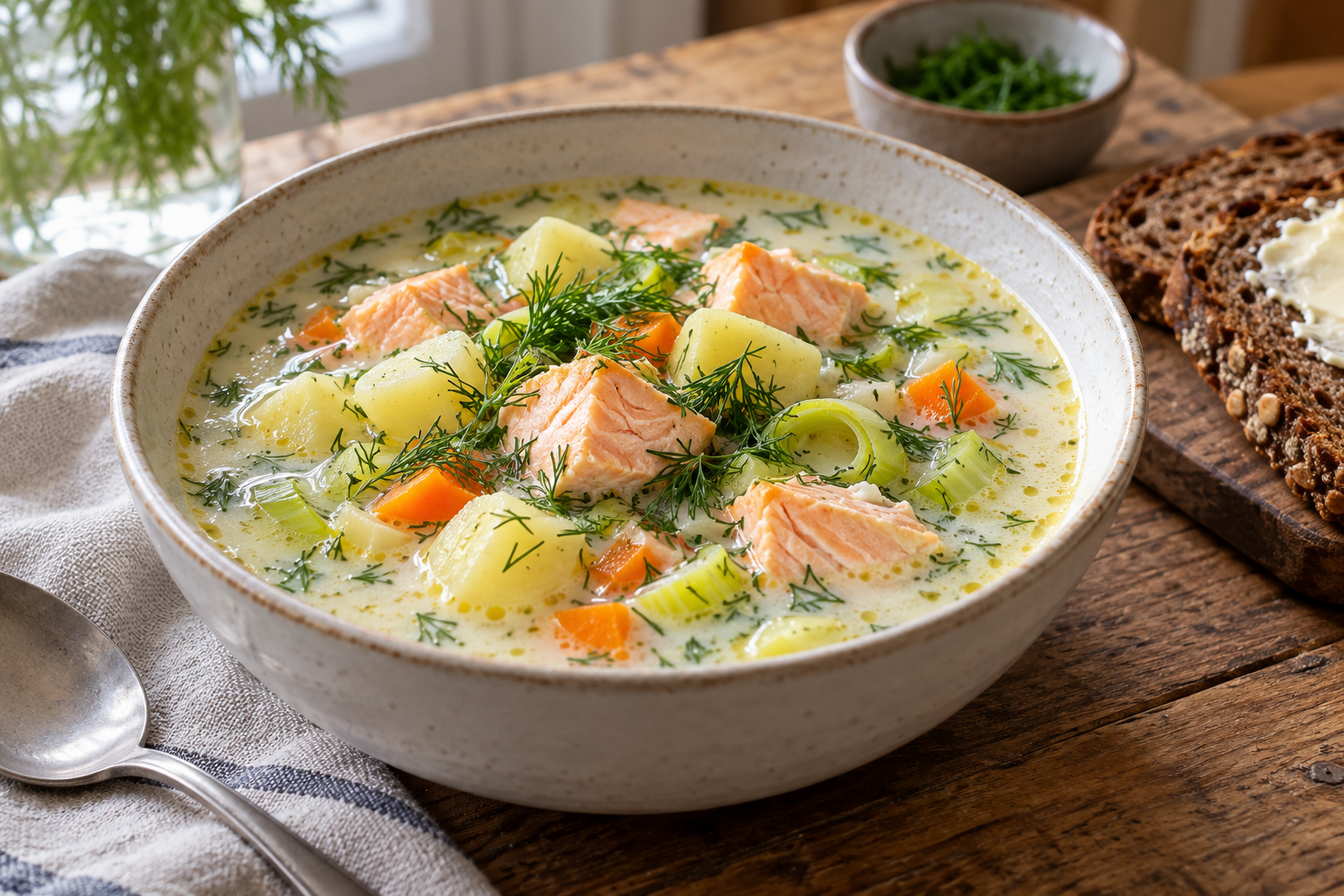
Lohikeitto rewards a little patience before the fish enters the pot. Let firm potatoes become tender in the broth first; then the salmon needs only a short, gentle cook. The result should be a spoonable soup with distinct pieces, not a pot of broken fish and potato mash.
A Finnish bowl, with more than one tradition
Lohikeitto is Finnish salmon soup. ThisisFINLAND places it in a northern recipe collection while noting its presence in homes and restaurants across the country. Cream is common, but it is not a requirement for every Finnish salmon soup: the same collection describes a Kainuu version thickened with rye flour instead. This recipe is a creamy home adaptation, not a claim to represent every region or family.
The regional tourism recipe from Visit Jyväskylä makes the timing particularly clear: soften the potatoes before adding cubed fish, and handle the fish gently. Here, a leek-and-carrot base gives the bowl a little sweetness, while dill is added at the end so its aroma stays fresh.
Lohikeitto: a creamy home version
Serves: 4 as a light main course with bread. Prep: 15 minutes. Cooking: about 30 minutes. Total: about 45 minutes. Equipment: a 3–4 litre saucepan, sharp knife and instant-read thermometer.
Editorial note: this is an original, source-informed home adaptation. It has not been independently kitchen-tested for SmartRestro; cooking times are guides, and the tenderness and temperature checks below take priority.
Ingredients
- 1½ tablespoons (20 g) unsalted butter
- 1 medium leek, white and light-green parts only, washed and thinly sliced (about 150 g prepared)
- 1 medium carrot, peeled and cut into small pieces (about 100 g)
- 1¼ pounds (550 g) firm yellow or waxy potatoes, peeled and cut into ¾-inch / 2 cm cubes
- 3⅓ cups (800 ml) low-sodium fish stock, plus a little more if needed
- 1 bay leaf and ¼ teaspoon freshly ground black pepper
- ¾ cup plus 1 tablespoon (200 ml) heavy cream
- 1 pound (450 g) skinless, pin-boned salmon, cut into 1-inch / 2.5 cm pieces
- ¼ cup chopped fresh dill (about 10 g), plus a little for serving
- Salt, to taste; start with ¼ teaspoon only if the stock is unsalted
- Rye bread, to serve
Method
- Prepare the fish and vegetables separately. Check the salmon carefully for pin bones and keep it refrigerated while preparing the vegetables. Rinse sliced leek well to remove trapped grit. Keep the potato cubes similar in size so they finish together.
- Soften the base without browning. Melt the butter over medium-low heat. Add the leek and carrot and cook for 6–8 minutes, stirring occasionally, until the leek is soft. If it catches, add a spoonful of stock and lower the heat.
- Give the potatoes their full cooking time. Add potatoes, stock, bay and pepper. Bring just to a boil, then reduce to a steady simmer and partially cover. Cook for 12–18 minutes, checking a cube with the tip of a knife. It should slide through easily with no firm centre. If the liquid drops below the vegetables, add a small splash of hot stock.
- Warm the cream before the fish goes in. Stir in the cream and return the soup to a gentle simmer. Taste the broth and add salt cautiously. Stock brands vary, so the final amount should follow the broth, not a fixed spoonful.
- Cook the salmon gently. Lower the salmon pieces into the hot soup and keep it at a bare simmer for about 4–6 minutes. Avoid vigorous stirring; gently move the pot or turn a piece with a spoon if needed. Check the thickest piece reaches 145°F / 63°C. The flesh should be opaque and separate easily. Larger or colder pieces may need longer.
- Finish off the heat. Remove the bay leaf, fold in the dill gently and taste again. Ladle into warm bowls, distributing the fish rather than stirring repeatedly. Serve promptly with rye bread.
Keep the texture, adjust the pantry
Why not add everything together? A potato that is still firm at its centre needs more time than a small salmon cube. Adding the fish early forces a choice between underdone potato and overcooked fish. If you discover a firm cube, leave the fish chilled while the vegetables finish.
Broth matters. Use a fish stock you like before adding it to the pot. Vegetable stock works as an accessible variation but changes the seafood flavour; avoid a strongly tomato-based or heavily spiced one. Water alone makes a noticeably lighter base.
Fish and dairy alternatives. Boneless trout can stand in for salmon; verify the same safe final temperature. For a dairy-free adaptation, use oil instead of butter and an unsweetened cooking cream alternative, following its heating instructions. This changes the flavour and is not the specific traditional cream version described above. Check stock and substitutes for allergens.
Serve a balanced bowl. The potatoes already provide substance, so a small slice of rye bread is enough alongside. If you enjoy Finnish dairy dishes, explore leipäjuusto with cloudberries for a very different finish to the meal.
Make ahead and store safely
For the best texture, prepare the vegetable-and-stock base ahead and add cream, salmon and dill when you are ready to eat. Cool the base promptly in shallow containers and refrigerate. Reheat it thoroughly before completing the fish step.
Refrigerate finished soup in shallow containers within 2 hours, or within 1 hour in temperatures above 90°F / 32°C, and keep the refrigerator at 40°F / 4°C or below. Use within 3 days as a conservative household limit. Reheat leftovers to 165°F / 74°C, bringing the soup to a boil as FDA guidance advises; expect the fish to become firmer. Reheat only the portion needed. Fish and milk are allergens; rye bread contains gluten.
Sources and image note
- ThisisFINLAND: northern Finnish recipes, including creamy and Kainuu salmon soups, supplied by Timo Lepistö.
- Visit Jyväskylä Region: Finnish Creamy Fish Soup, by Leena Pölkki, for potato-first timing and gentle fish handling.
- FDA: Safe Food Handling, for cooking, chilling and reheating guidance.
Cover: original AI-generated serving illustration, not a photograph of a tested batch. It depicts the ingredients and intended texture of this adaptation.


