
Mexican Burrito
Burrito norteño
In northern Mexico, a burrito is often a supple flour tortilla wrapped around one focused guisado rather than an oversized bundle of many fillings. Its strength lies in the balance between a resilient tortilla and a savory filling dry enough to travel cleanly.
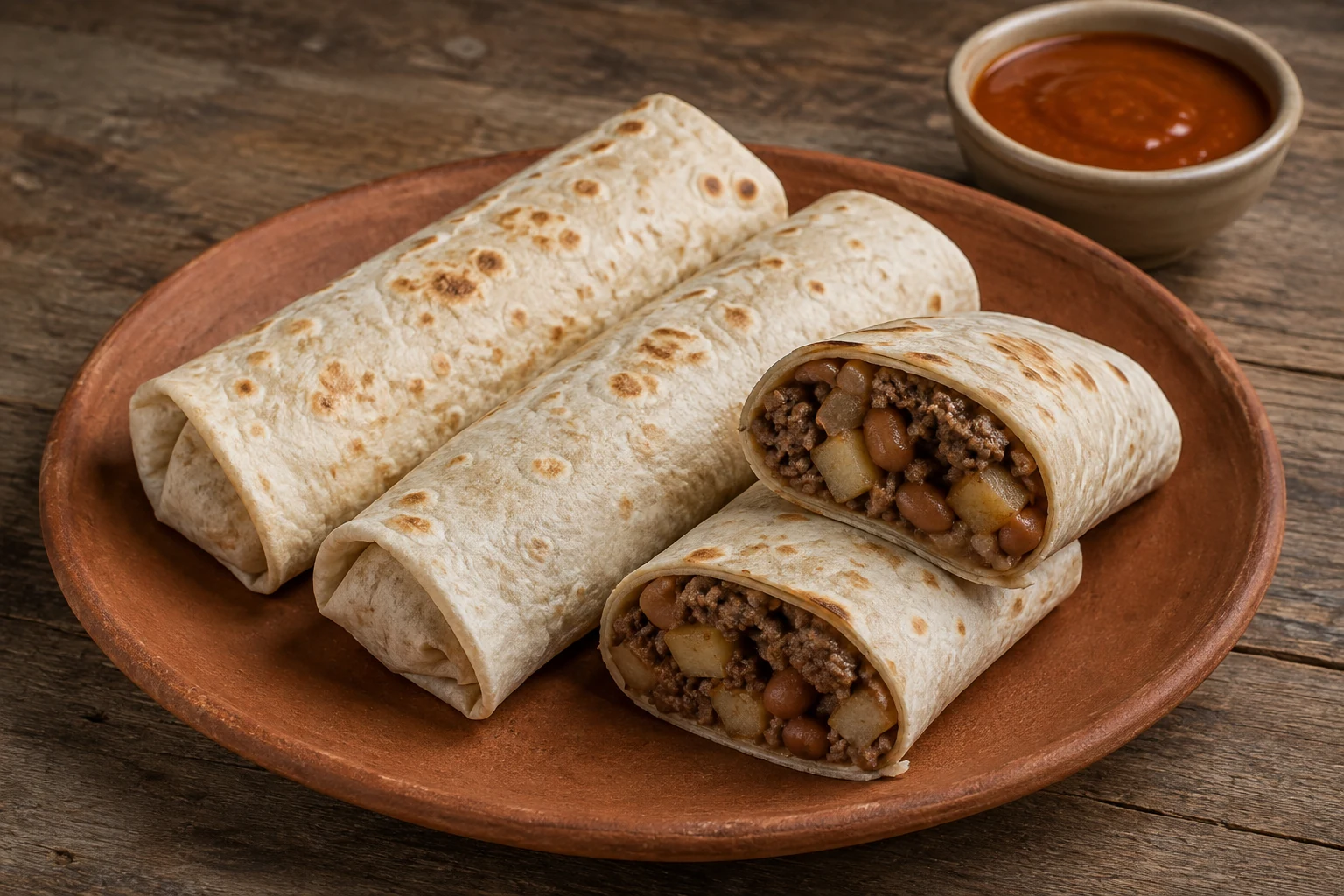
The word burrito can suggest very different meals. In much of the United States it may mean a large foil-wrapped tortilla packed with rice, beans, meat, cheese, and several condiments. Across northern Mexico, the form is commonly leaner: a flexible wheat-flour tortilla, a measured portion of a single stew or combination, and a tight roll that can be eaten without a plate.
This recipe takes its cue from Chihuahua. A Mexican public-education text identifies the burrito chihuahuense as a rolled flour tortilla filled with shredded beef, potatoes, and beans. The home version below keeps that documented trio but uses ground beef for a quicker picadillo; that choice is an editorial adaptation, not a claim that every Chihuahua burrito is made this way.
A northern Mexican family of foods
Larousse Cocina defines the burrito or burrita as a rolled flour tortilla with its edges folded around fillings that may range from carne asada to refried beans. It places the antojito—a prepared snack or light meal—especially in Mexico's northern states and notes that size, filling, and even the tortilla change from place to place.
That regional frame matters. Larousse records lobster-and-machaca burritas in Baja California, chilorio or shredded pork in Sinaloa, machaca and carne seca with chile colorado in Sonora, and shredded beef or melted Chihuahua-style cheese in Chihuahua. Gustavo Arellano's account of roadside burritos in Villa Ahumada adds rajas with cheese and picadillo, and describes rolls whose ends are left open. A burrito is therefore a format with local expressions, not one fixed ingredient list.
What the history can—and cannot—prove
The exact origin is unsettled. Arellano reports that historians have traced the term burrito to an 1895 Mexican source, where it referred to a tortilla rolled around ingredients, but he also stresses that no inventor is known. That documentary trail is a better foundation than the often repeated tale of a Ciudad Juárez vendor whose donkey supposedly gave the food its name.
The tortilla itself explains the dish's geography. Larousse describes wheat-flour tortillas as especially important in northern Mexico and records distinct regional formats: Chihuahua tortillas may include baking powder for lift, while Sonoran tortillas can be exceptionally thin and wide. Whatever the filling, a burrito depends on a tortilla that is both tender and strong enough to bend without tearing.
A related but distinct borderland evolution
Northern Mexican and Mexican American burritos belong to a shared borderlands story, but their styles should not be collapsed into one. A City of San Francisco Legacy Business report describes the Mission-style burrito as a large format that became popular in the Mission District in the 1960s, commonly adding rice and other fillings and using foil for service. The report also preserves competing restaurant creation claims, so even this more recent style has lore that should be treated cautiously.
The recipe here is not a Mission burrito. It stays closer to the narrower northern Mexican balance documented by Larousse, the Mexican education source, and Arellano: warm flour tortilla, one cohesive guisado, beans, and salsa served alongside rather than a long list of cool toppings packed inside.
Technique: pliable tortilla, reduced filling
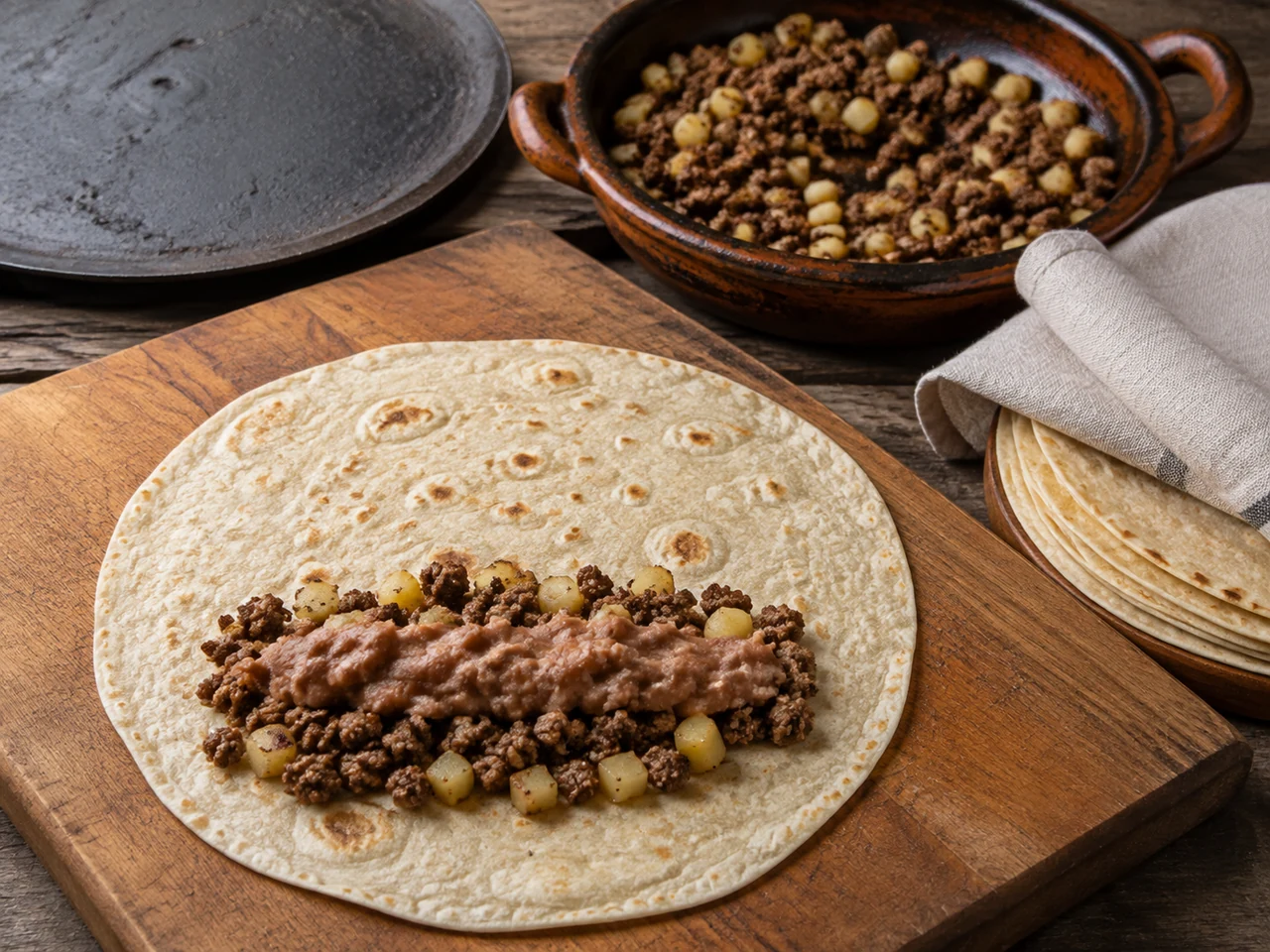
Two textures make the roll work. First, the tortilla must be warmed briefly on a dry comal or skillet until supple; a cold flour tortilla tends to split at the fold. Second, the picadillo must finish moist but not soupy. Reducing the tomato-and-ancho mixture until a spatula leaves a clean path in the pan concentrates flavor and prevents liquid from soaking through the wrapper.
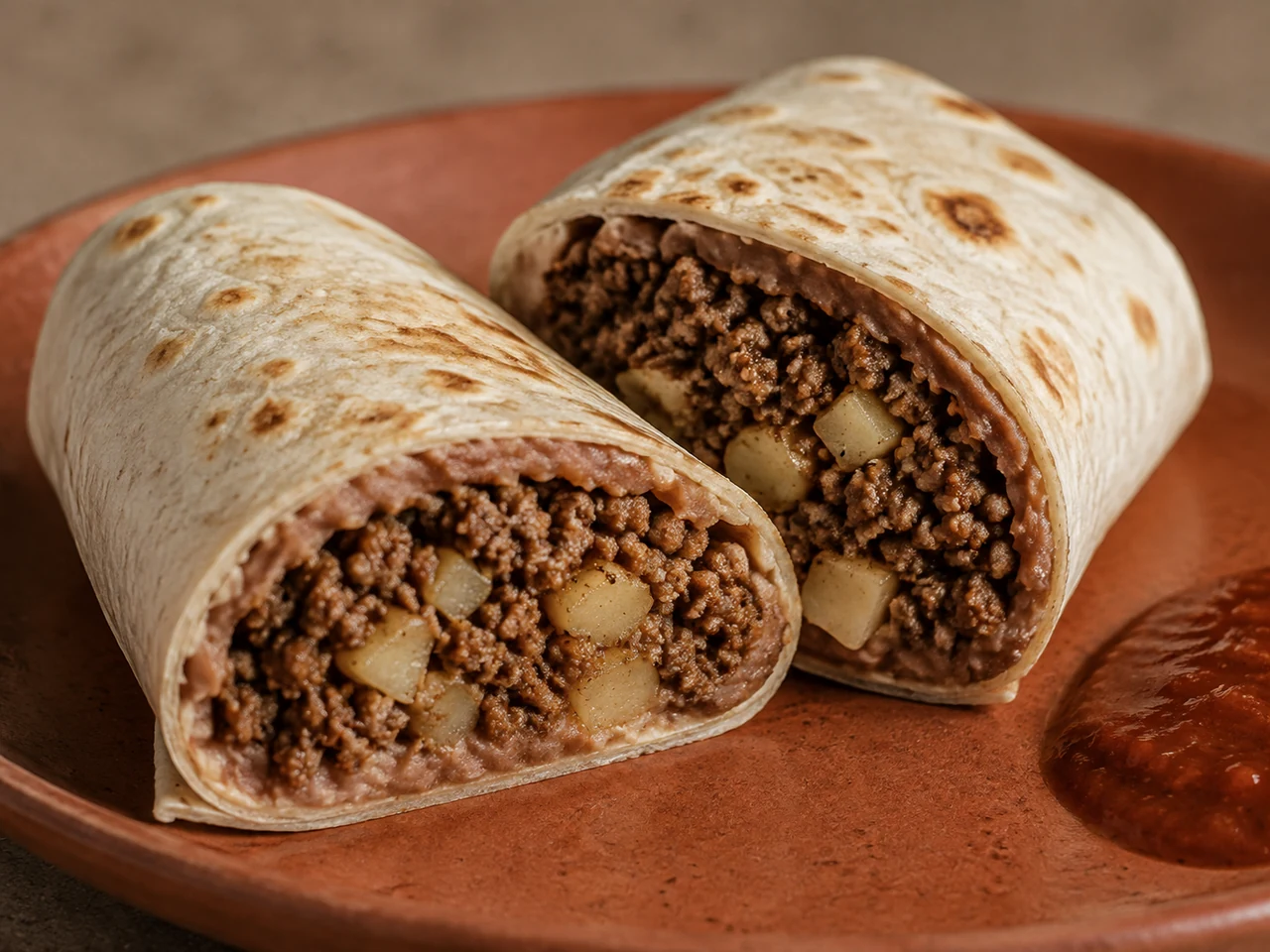
The small potato cubes should be tender without collapsing, the beef should remain finely crumbled, and the beans should be mashed just enough to spread. Place the filling below the tortilla's center, fold in the sides, and roll away from you with gentle tension. The result should feel compact in the hand, with a soft tortilla around a cohesive, savory center.
Cook it at home
Northern-style beef, potato, and bean burritos
This practical version makes eight slender burritos. Its filling echoes documented northern Mexican combinations, while ground beef shortens the cooking time; keep the guisado well reduced and the tortillas warm for clean rolling.
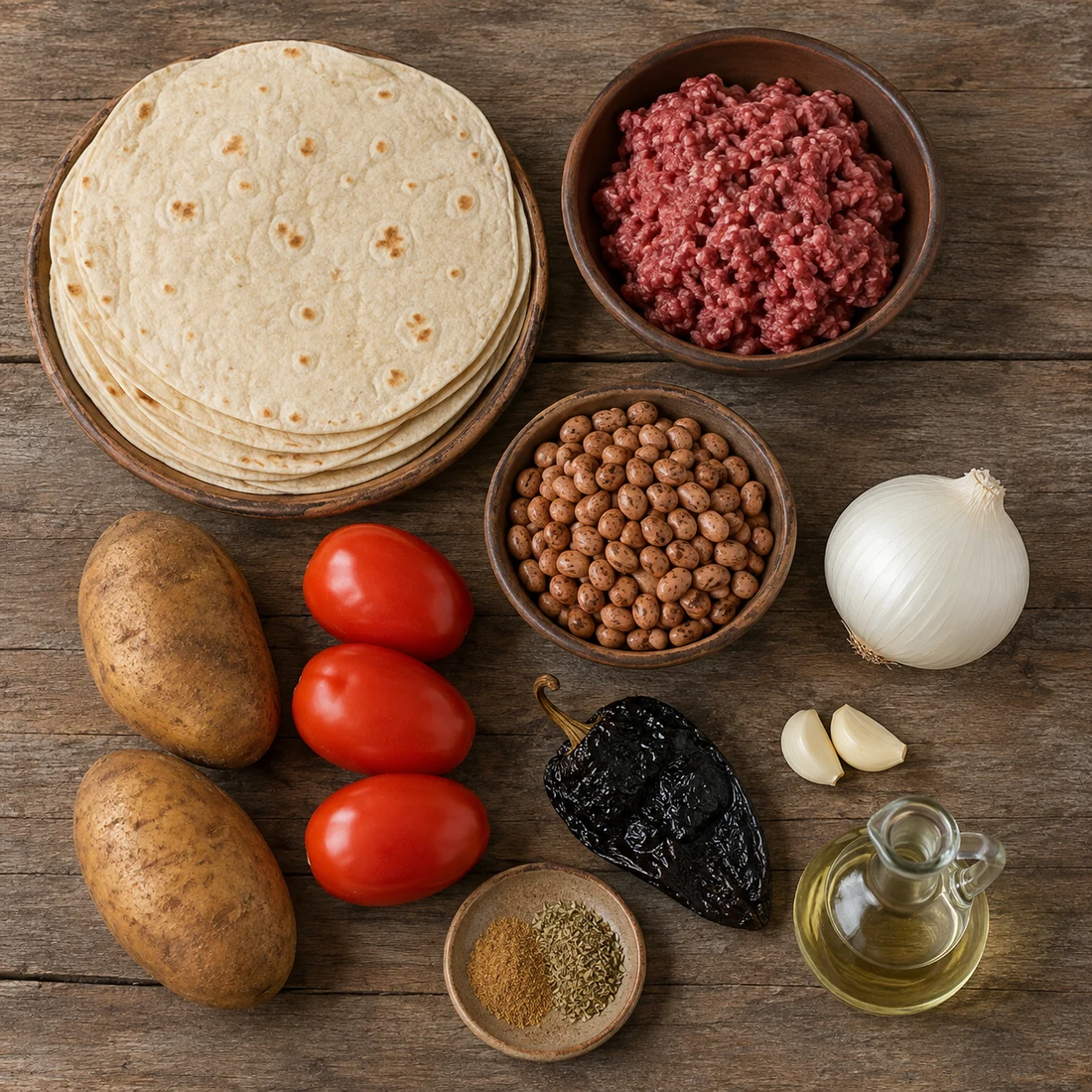
Ingredients
For the ancho picadillo
- 1 dried ancho chile, stemmed and seeded
- 240 ml (1 cup) just-boiled water, for soaking
- 250 g (2 medium) Roma tomatoes, quartered
- 2 garlic cloves, peeled
- 120 ml (1/2 cup) water
- 1 tbsp neutral cooking oil
- 75 g (1/2 medium) white onion, finely diced
- 340 g (12 oz) ground beef
- 200 g (about 1 medium) russet potato, peeled and cut into 1 cm cubes
- 1/2 tsp ground cumin
- 1/2 tsp dried Mexican oregano, crushed
- 1 1/4 tsp fine sea salt, divided
- 1/4 tsp freshly ground black pepper
For the beans and assembly
- 180 g (about 1 cup) cooked pinto beans, drained
- 60 ml (1/4 cup) water
- 8 wheat-flour tortillas, about 25 cm (10 inches) wide
- 120 ml (1/2 cup) prepared red chile salsa, to serve, optional
Method
- 1
Soften the ancho chile.
Toast the ancho in a dry skillet over medium heat for about 10 seconds per side, just until fragrant; do not let it blacken. Put it in a heatproof bowl, cover with the 240 ml just-boiled water, and soak for 10 minutes. Drain and discard the soaking water.
- 2
Blend the sauce.
Blend the softened ancho with the tomatoes, garlic, and 120 ml water until very smooth, scraping down the jar as needed. Set the brick-red sauce aside.
- 3
Par-cook the potato.
Put the potato cubes in a small saucepan, cover with cold water, and bring to a gentle boil. Cook for 5 to 6 minutes, until the outside is tender but the center still offers resistance. Drain well; the potato will finish cooking in the sauce.
- 4
Brown the beef safely.
Heat the oil in a wide skillet over medium-high heat. Cook the onion for 3 minutes, until translucent. Add the beef, cumin, oregano, black pepper, and 3/4 teaspoon of the salt. Cook for 6 to 8 minutes, breaking the meat into fine crumbles, until no raw patches remain and the center of the meat reaches 71°C (160°F) on a food thermometer. Do not judge safety by color alone.
- 5
Reduce the picadillo.
Stir in the drained potato, blended sauce, and 1/4 teaspoon salt. Bring to a lively simmer, then lower the heat to medium and cook uncovered for 10 to 12 minutes, stirring often. The potato should be tender and the mixture ready when a spatula drawn across the pan leaves a path that does not immediately flood. Remove from the heat and rest for 5 minutes.
- 6
Mash the beans.
Meanwhile, combine the pinto beans, 60 ml water, and remaining 1/4 teaspoon salt in a small saucepan. Warm over medium-low heat for 4 to 5 minutes, then mash until mostly smooth but still textured. Cook for another minute if loose; the beans should spread without running.
- 7
Warm the tortillas.
Heat each tortilla on a dry comal or skillet over medium heat for about 15 to 20 seconds per side, only until warm and flexible. Stack them under a clean cloth as you work so they do not dry out.
- 8
Fill and roll.
Working with one warm tortilla at a time, spread one-eighth of the beans—about 1 1/2 tablespoons—in a narrow band just below center. Top with one-eighth of the picadillo, about a generous 1/3 cup. Fold the left and right edges inward, bring the bottom edge over the filling, and roll forward snugly. Rest seam-side down for 1 minute. Serve warm with salsa alongside.
Kitchen notes
Details that make the burritos work
Reduce before rolling
If liquid quickly closes the trail left by your spatula, keep simmering. A spoonable but not wet picadillo protects the tortilla from tearing and keeps the cross-section distinct.
Keep tortillas covered
Warm only until flexible and hold the stack under a cloth. Excessive dry heat makes the edges crisp, while exposure to air lets a warm tortilla stiffen before it can be folded.
Measure the first one
Use roughly 1 1/2 tablespoons beans and a generous 1/3 cup picadillo for the first burrito. If the tortilla resists closing, reduce the portion rather than stretching the wrapper.
Use a thermometer
USDA guidance calls for ground beef to reach 71°C (160°F) as measured with a food thermometer; browned color by itself is not a reliable safety test.
Research notes
Sources behind this article
- Larousse Cocina — Burrito, a Mexican culinary dictionary entry used for the dish definition, folded form, northern context, and documented state-by-state fillings.
- Larousse Cocina — Tortilla de harina Mexican culinary reference used for flour-tortilla ingredients, comal cooking, northern prevalence, and regional differences in size and texture.
- Secretaría de Educación Pública — Comida mexicana Mexican public-education source identifying the Chihuahua burrito as a rolled flour tortilla with shredded beef, potatoes, and beans.
- Saveur — Burritos Unwrapped Gustavo Arellano's food-history and local account used for the uncertain origin, the 1895 terminology, Villa Ahumada proportions, and regional fillings.
- Embassy of Mexico in Bolivia — Gastronomy bulletin Mexican diplomatic publication used to identify the Juan Méndez donkey-vendor account as a story that conflicts with the earlier 1895 dictionary record.
- PROFECO — Picadillo norteño Mexican consumer-agency source corroborating a northern picadillo combination of ground beef, potato, ancho chile, tomato, and beans.
- City of San Francisco — El Faro Legacy Business report Municipal historical report used to distinguish the large, rice-inclusive Mission-style burrito and to acknowledge competing creation claims.
- USDA FSIS — Ground beef doneness and color Current official food-safety guidance for cooking ground beef to 160°F with a thermometer and not relying on color alone.
Keep exploring
More stories for your table
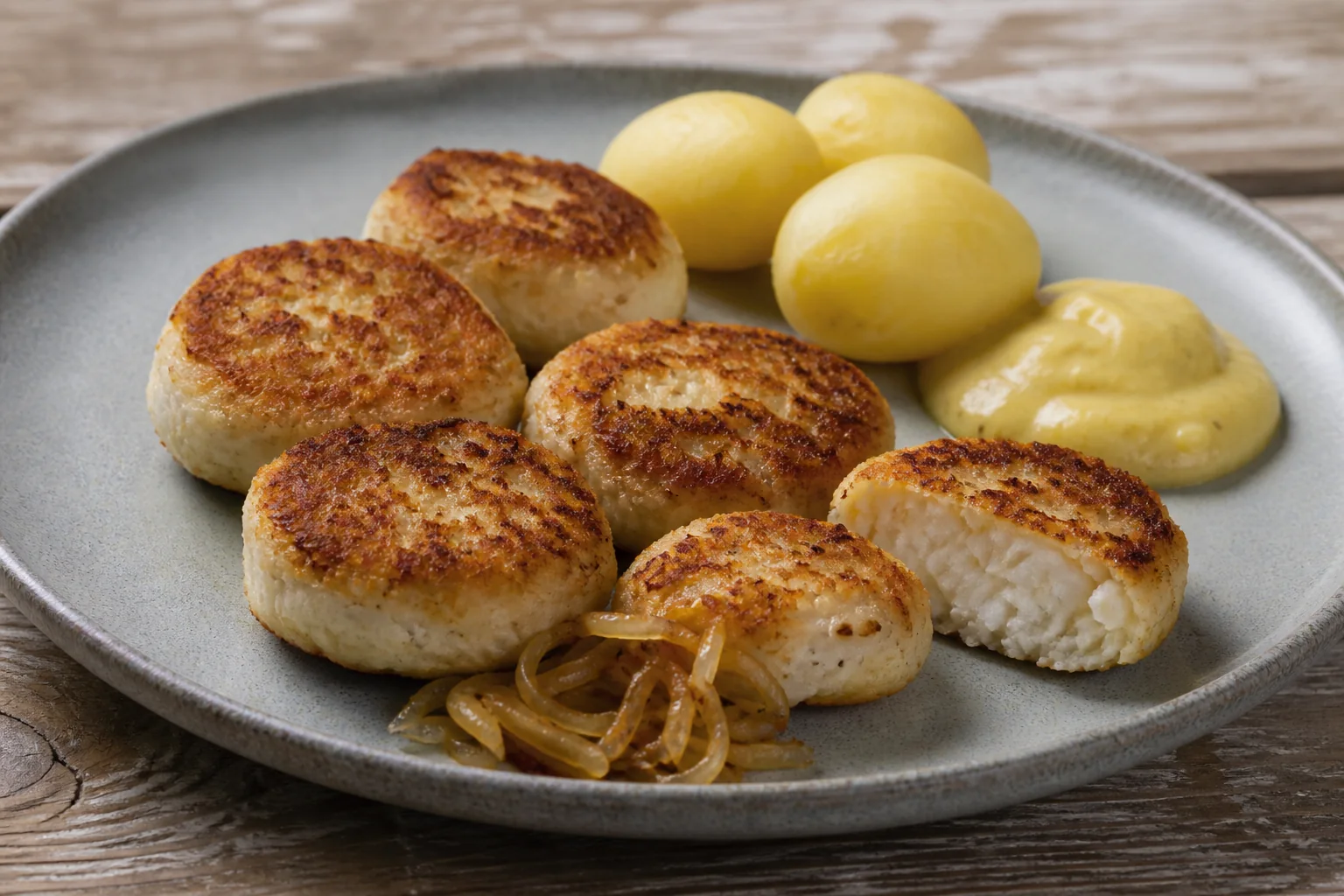
IcelandEveryday cooking
Icelandic fish balls
A crisp, golden crust around tender white fish, served with boiled potatoes, soft onions, and mild curry sauce.
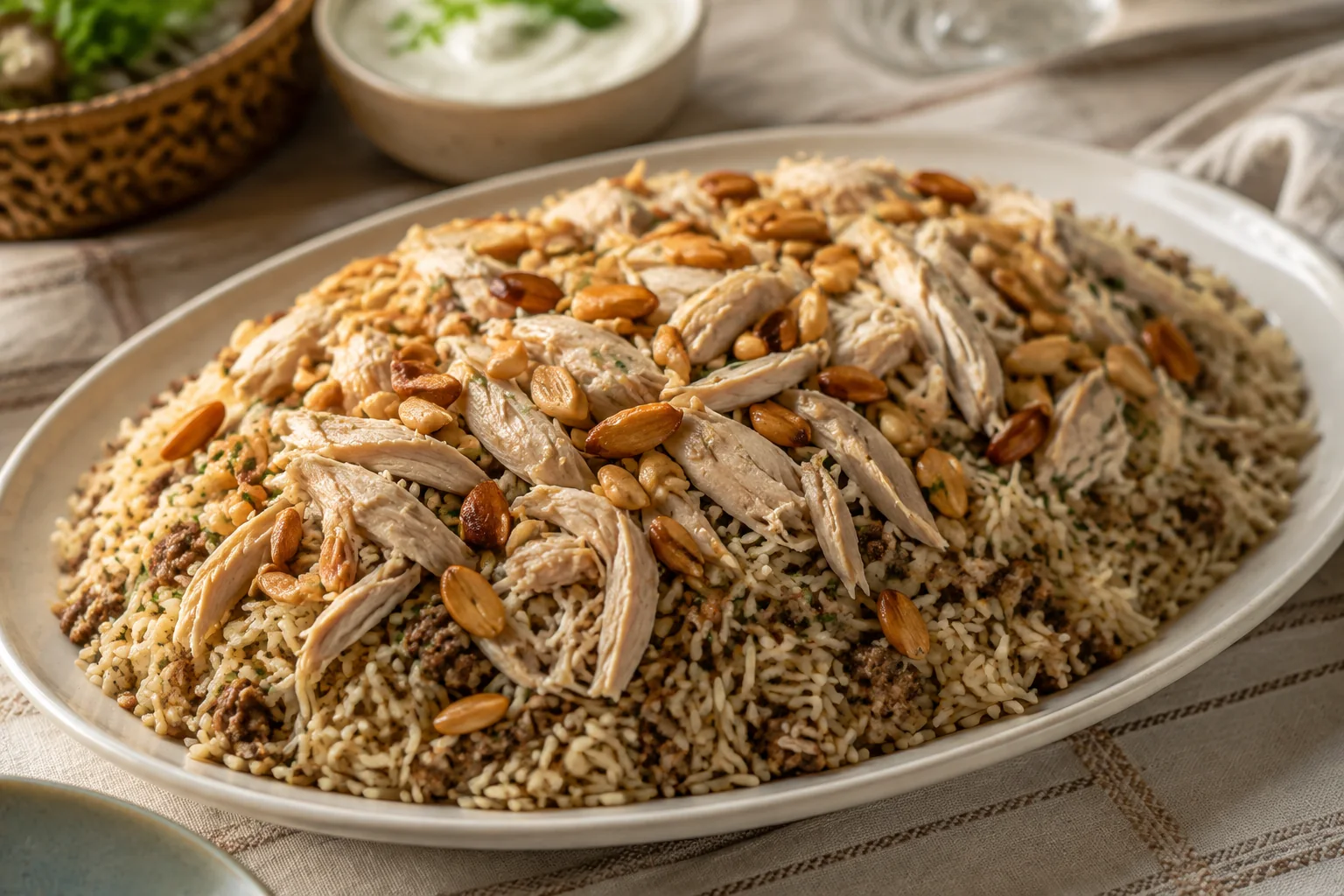
LebanonGathering table
Riz bi Djej
Fragrant rice and finely browned meat, crowned with tender chicken and a generous scatter of toasted nuts.
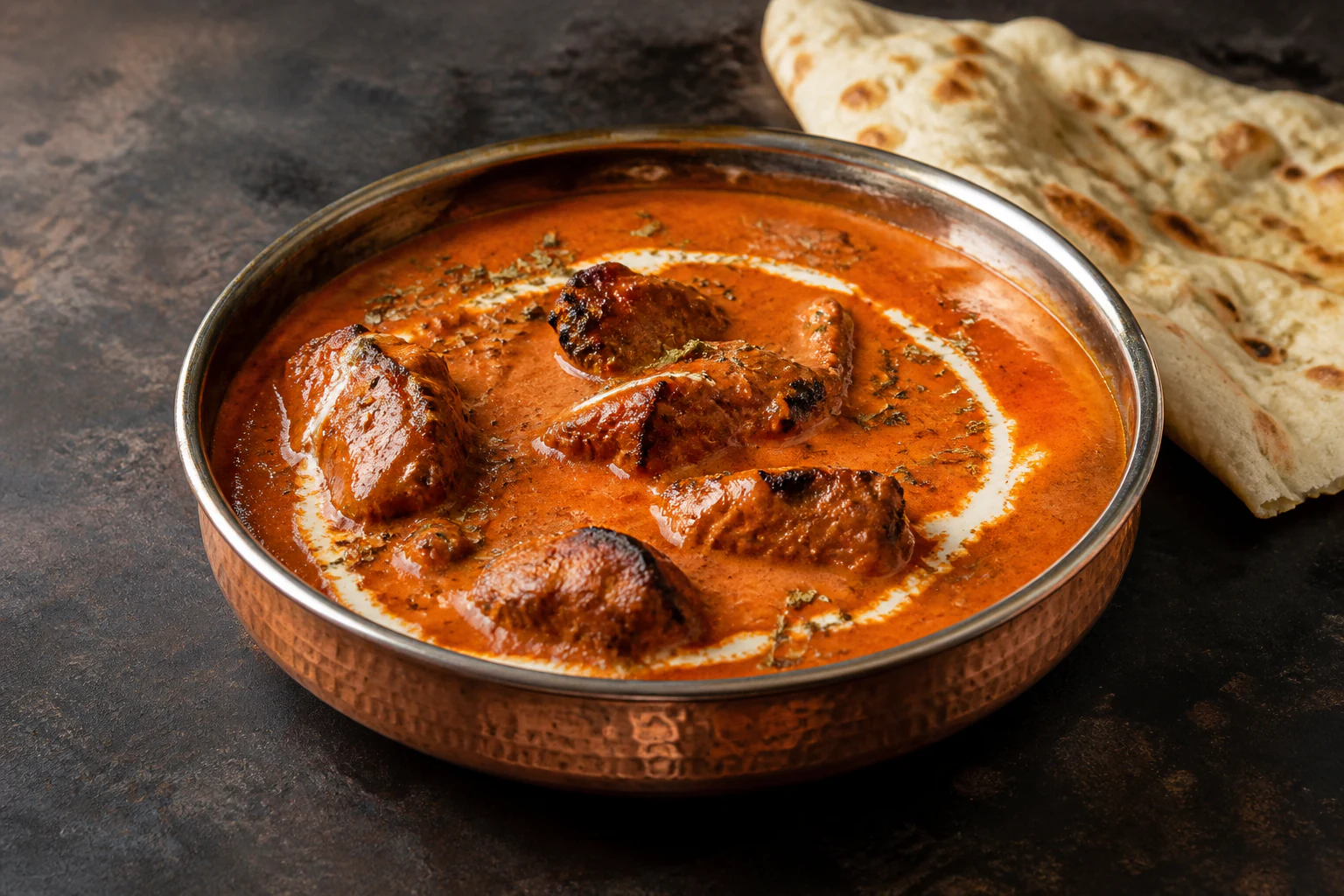
IndiaChicken curry
Butter Chicken (Murgh Makhani)
Delhi's celebrated butter chicken pairs high-heat-roasted, yogurt-marinated chicken with a smooth tomato gravy finished with butter, cream, and dried fenugreek.