
Shui Zhu Yu (Sichuan Water-Boiled Fish)
水煮鱼
Its quiet name describes only half the method. Shui Zhu Yu protects delicate fish in a seasoned poach, then lets a measured rush of hot oil turn chile and Sichuan pepper into the dish’s fragrant final voice.
A name in two acts
The fish is water-boiled. The aroma is not.
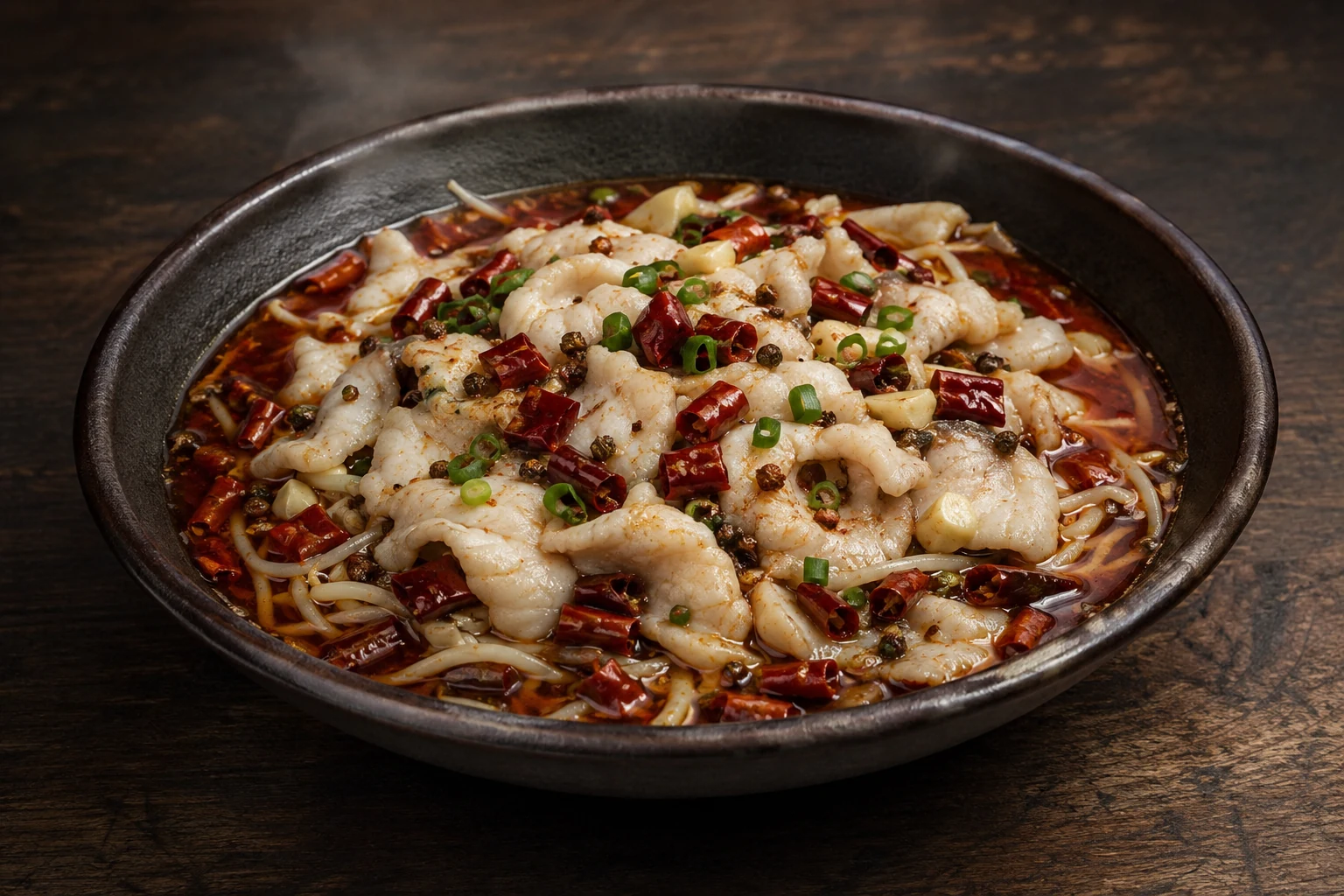
Shui Zhu Yu translates plainly as “water-boiled fish,” but the finished bowl seems to argue back: white fish lies beneath dried red chiles, Sichuan pepper, and a glinting red-brown surface. The contradiction disappears once the method is read as a handoff. Seasoned liquid cooks the fish; hot oil wakes the aromatics at the last moment.
That division of labor is why tenderness and intensity can occupy the same bowl. The fish is sliced, lightly coated, and poached only until done. Doubanjiang gives the cooking liquid salt, fermented depth, and color. The final oil is not a second long cooking stage; it is a brief aromatic release over the chiles and pepper already waiting on top.
The dish belongs to the Chongqing and wider Sichuan culinary world, where mala is a relationship rather than a synonym for indiscriminate heat. Chile contributes warmth; Sichuan pepper contributes a separate tingling sensation associated with hydroxy-alpha-sanshool. The aim is not to erase the fish, but to make each mild slice carry both signals.
Three jobs, one bowl
Each layer controls a different part of the experience
The method becomes easier to understand when the poach, the oil, and the vegetable base are treated as separate tools rather than one undifferentiated red soup.
The seasoned liquid
A doubanjiang base seasons the fish as it cooks. A gentle simmer and short exposure protect the thin slices from tightening and breaking.
- Cook to safe doneness
- Keep the simmer restrained
- Move the fish only when necessary
The hot-oil finish
A final pour over dried chile, Sichuan pepper, garlic, and scallion releases aroma at the surface. The oil is a carrier and seasoning, not a broth to drink.
- Use a dry heatproof bowl
- Pour away from the face
- Serve immediately after the sizzle
The vegetable bed
Blanched bean sprouts sit beneath the fish, adding crispness and lifting the slices out of the deepest liquid while catching some of the seasoned broth.
- Drain very well
- Spread in an even layer
- Keep the texture just crisp-tender
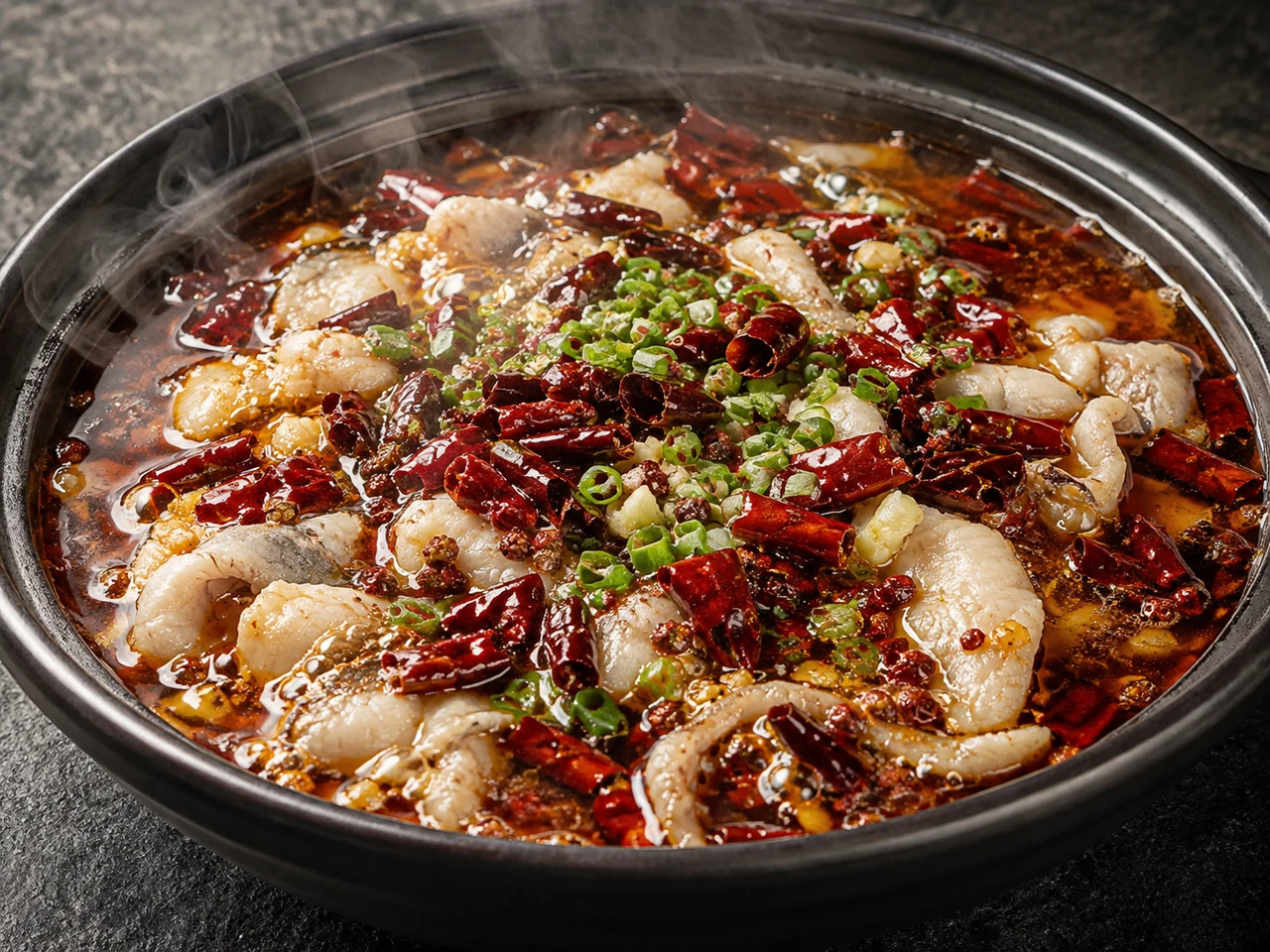
Read the transformation
Six control points from pale fish to fragrant bowl
Restaurant versions can be enormous and oil-heavy. The same architecture works at home when the quantities are smaller and the visual cues stay precise.
- 01
Slice for an even finish
Use boneless fillet and cut it on a slight bias into pieces of similar thickness. Uneven slices force a choice between undercooking thick pieces and drying thin ones.
- 02
Build a thin protective coat
Salt and wine season the fish; egg white, starch, and a spoonful of water form a light coating. It should feel tacky, not sit under a heavy batter.
- 03
Prepare the bowl first
Blanch the sprouts until just flexible, drain them thoroughly, and spread them in a dry heatproof serving bowl. Once the fish enters the poach, the sequence moves quickly.
- 04
Fry doubanjiang until the oil colors
Warm chile, Sichuan pepper, ginger, garlic, and scallion in oil, then fry the chopped broad-bean chile paste until its raw edge softens and the oil turns red. Only then add the cooking liquid.
- 05
Poach without a rolling boil
Slide in the fish and hold the liquid at a gentle simmer. Separate slices carefully, then stop as soon as the thickest piece reaches 145°F / 63°C; violent boiling works against the coating and texture.
- 06
Bloom, then bring it straight to the table
Arrange the dry finishing aromatics over the fish. Heat the measured oil until shimmering, turn off the burner, and pour it steadily over several spots so the chiles and pepper release fragrance without scorching in one mound.
What the record supports
A modern Chongqing dish with an often-retold origin
The broad geography is well supported; the precise invention narrative comes from later profiles and deserves attribution rather than certainty.
- Before the named dish
Hot-pot fish supplies a predecessor
Chongqing’s local-records office describes Cuiyun Shui Zhu Yu as descending from the city’s hot-pot fish tradition, placing the dish in a local culture of boldly seasoned freshwater fish.
- 1983
A related water-boiled technique wins notice
A 2012 Chongqing Morning Post profile, republished by China Economic Net, says Yubei cook Tian Zhongming won a Chongqing competition with an innovative water-boiled pork dish. The competition dish was pork, not fish.
- Later, by that account
The method moves from pork to fish
The same retrospective profile says a friend brought fresh grass carp and Tian adapted the technique to fish. This is the best-known creation story, but the available source is not a contemporaneous record of the moment.
- 1990s
From Yubei specialty to national centerpiece
The profile records a cluster of water-boiled-fish restaurants around Yubei by the mid-1990s. China Daily’s account places Shui Zhu Yu at the center of China’s late-1990s Sichuan-food boom.
Ingredient map
What to notice beneath the red surface
- Fish
- Freshwater in many restaurant accounts
- Doubanjiang
- Fermented broad bean and chile
- Dried chile
- Warmth, color, toasted aroma
- Sichuan pepper
- Tingle distinct from chile burn
- Bean sprouts
- A crisp vegetable foundation
- Finishing oil
- Aromatic carrier, not soup
The Yubei origin story names grass carp, while a university-published method uses snakehead. This home version uses accessible boneless white-fish fillets and identifies that choice as an adaptation.
China’s national intangible-cultural-heritage catalog calls Pixian doubanjiang an important Sichuan seasoning and documents its long fermentation tradition.
Some chile seasons the broth; the rest waits on the surface for the final oil. Removing some loose seeds moderates heat without changing the structure.
Sensory research links the characteristic buzzing and tingling to hydroxy-alpha-sanshool, helping explain why mala is experienced as two interacting sensations.
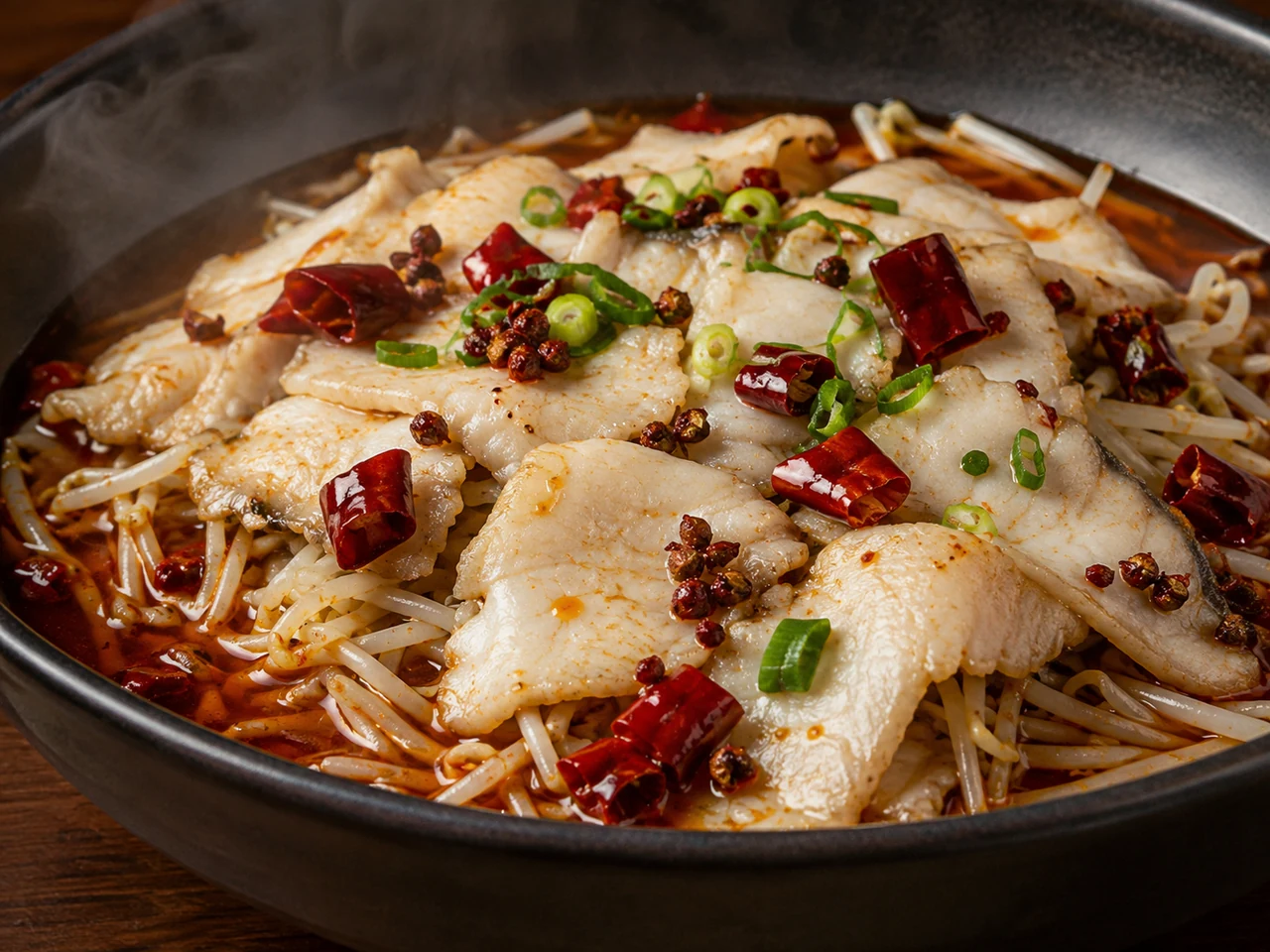
The documented cooking method places blanched sprouts below the fish. They provide contrast and keep the bowl from being only soft fish and liquid.
China Daily’s description is direct: diners lift out the fish, while the fragrant oil itself is not intended to be eaten by the spoonful.
Look closely
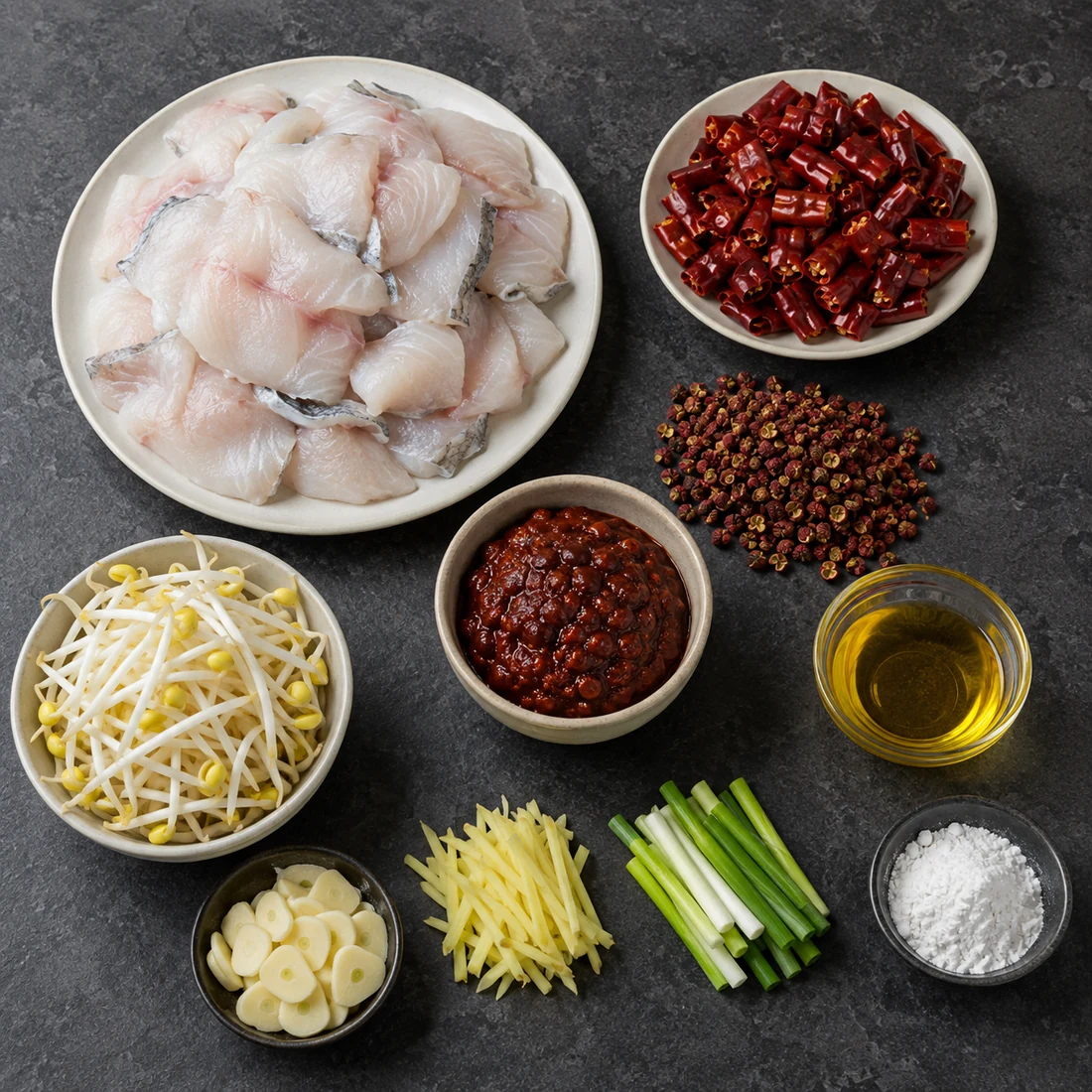
The mise en place and the texture it protects
The strongest contrast is not merely red against white; it is dry spice against moist fish, fermented paste against fresh sprouts, and high finishing heat against a restrained poach.
Cook the architecture
Shui Zhu Yu — measured home adaptation
This four-serving version preserves the documented sequence—seasoned fish, sprouts, doubanjiang broth, then a hot-oil bloom—while using boneless fillets and substantially less finishing oil than a restaurant centerpiece. Measure and divide every aromatic before starting.
Ingredients
Fish and light coating
- 680 g / 1½ lb boneless, skinless firm white-fish fillets, sliced on a bias about 6 mm / ¼ inch thick
- 1 tsp fine salt
- 1 tbsp Shaoxing wine or dry sherry
- 1 large egg white
- 2 tbsp potato starch or cornstarch
- 1 tbsp cold water
Vegetable base, broth, and finish
- 300 g / 10½ oz mung bean sprouts, rinsed and drained
- 6 tbsp rapeseed or canola oil, divided: 2 tablespoons for the broth and 4 tablespoons for finishing
- 30 g / about 1 packed cup dried red chiles, cut into 2.5 cm / 1 inch pieces and divided: 10 g for the broth, 20 g for finishing; shake out loose seeds to moderate the heat
- 1 tbsp red Sichuan peppercorns, lightly crushed and divided: 1 teaspoon for the broth, 2 teaspoons for finishing
- 3 tbsp Pixian doubanjiang, finely chopped
- 20 g / about 1½ tbsp fresh ginger, peeled and finely slivered
- 6 cloves garlic, divided: 3 thinly sliced for the broth and 3 finely chopped for finishing
- 4 scallions, whites thinly sliced and greens cut into rings, kept separate
- 720 ml / 3 cups unsalted fish stock or water
- 1 tbsp light soy sauce
- 1 tsp granulated sugar
Method
- 1
Organize the divisions.
Set a wide, dry heatproof serving bowl on a stable surface. Keep the 10 g of broth chiles and 1 teaspoon of broth peppercorns beside the stove; combine the remaining 20 g chiles and 2 teaspoons peppercorns for the finish. Separate the sliced garlic from the chopped garlic and the scallion whites from the greens.
- 2
Coat and rest the fish.
Put the fish in a medium bowl. Add the salt and Shaoxing wine and gently turn until absorbed. Add the egg white, starch, and cold water; fold just until every slice carries a thin, tacky coat. Refrigerate for 15 minutes while preparing the sprouts and broth.
- 3
Blanch the vegetable base.
Bring a medium pot of water to a boil. Add the bean sprouts and blanch for 60 to 90 seconds, until just flexible but still crisp. Drain thoroughly, shake off surface water, and spread them across the bottom of the heatproof serving bowl. Dry the pot before returning it to the stove.
- 4
Build the red broth.
Heat 2 tablespoons of the oil in the dry pot over medium heat. Add the reserved 10 g chiles and 1 teaspoon peppercorns; stir for 20 to 30 seconds, until fragrant but not blackened. Add the ginger, sliced garlic, and scallion whites and stir 30 seconds. Add the chopped doubanjiang and fry for 1 to 2 minutes, until the oil is red and the paste smells rounded rather than raw. Stir in the stock, soy sauce, and sugar. Bring to a boil, lower to a steady simmer, and cook for 5 minutes.
- 5
Poach to safe doneness.
Lower the broth to a gentle simmer. Slide in the fish slices one at a time, distributing them across the pot, and wait 30 seconds before nudging apart any that touch. Cook for 2 to 4 minutes, without a rolling boil, until the thickest slice reaches 145°F / 63°C. Lift the fish onto the sprouts with a slotted spoon, then ladle about 360 ml / 1½ cups broth around it.
- 6
Arrange the finishing aromatics.
Scatter the chopped garlic, reserved 20 g chiles, reserved 2 teaspoons peppercorns, and scallion greens evenly over the fish. Keep the bowl stable, its rim and exterior dry, and the path from stove to bowl clear.
- 7
Bloom and serve.
Heat the remaining 4 tablespoons oil in a small saucepan over medium-high heat until shimmering. Turn off the burner. Holding the pan away from your face, pour the oil slowly over several areas of the aromatic topping; it should sizzle without violent spattering. Carry the bowl to the table only after the sizzle settles. Serve with plain rice, lifting out fish and sprouts rather than treating the oil as soup.
Research notes
Sources behind this story
Local and institutional sources establish the dish’s Chongqing setting, cooking sequence, and ingredients. The exact invention account is retrospective and is identified that way above; no useful Internet Archive capture of the former SmartRestro URL was available.
- Chongqing Local Records Office — notable local dishes Identifies Cuiyun Shui Zhu Yu as a Chongqing specialty descended from local hot-pot fish and describes its fish, chile, pepper, and red-oil profile.
- China Economic Net / Chongqing Morning Post — Yubei origin profile Provides the retrospective Tian Zhongming account, the 1983 water-boiled-pork competition detail, the later fish adaptation, and the mid-1990s Yubei restaurant cluster.
- Beijing Technology and Business University food school — Shui Zhu Yu method Documents a complete preparation sequence: season sliced fish, blanch sprouts, fry aromatics and Pixian doubanjiang, poach the fish, and finish with hot oil over chile and pepper.
- Sichuan University — teaching the water-boiled technique Records a Sichuan cooking instructor’s related three-temperature framework for frying chile and pepper, frying doubanjiang, and applying the hotter final aromatic pour.
- China Daily — Shui Zhu Yu as a Sichuan restaurant centerpiece Supports the late-1990s popularity context and describes poached fish, dried chiles, Sichuan pepper, the dramatic oil finish, and how the oil is treated at the table.
- China Intangible Cultural Heritage — Pixian doubanjiang craft Documents fermented Pixian doubanjiang as an important Sichuan seasoning built from local broad beans and chiles, with a protected traditional production craft.
- Nature Neuroscience / PubMed Central — the sensation of Sichuan pepper Peer-reviewed research identifies hydroxy-alpha-sanshool as chiefly responsible for Sichuan pepper’s characteristic tingling and buzzing, distinct from chile’s capsaicin burn.
- China Sichuan Food — Shui Zhu Yu technique and home proportions Corroborates the sliced-fish approach, starch coating, doubanjiang base, brief poach, bean-sprout foundation, finishing aromatics, and a modest hot-oil pour for a home kitchen.
- U.S. Food and Drug Administration — selecting and serving seafood safely Provides current handling guidance and the 145°F / 63°C internal-temperature recommendation used for the fish in the home recipe.
Keep exploring
More stories for your table
IcelandEveryday cooking
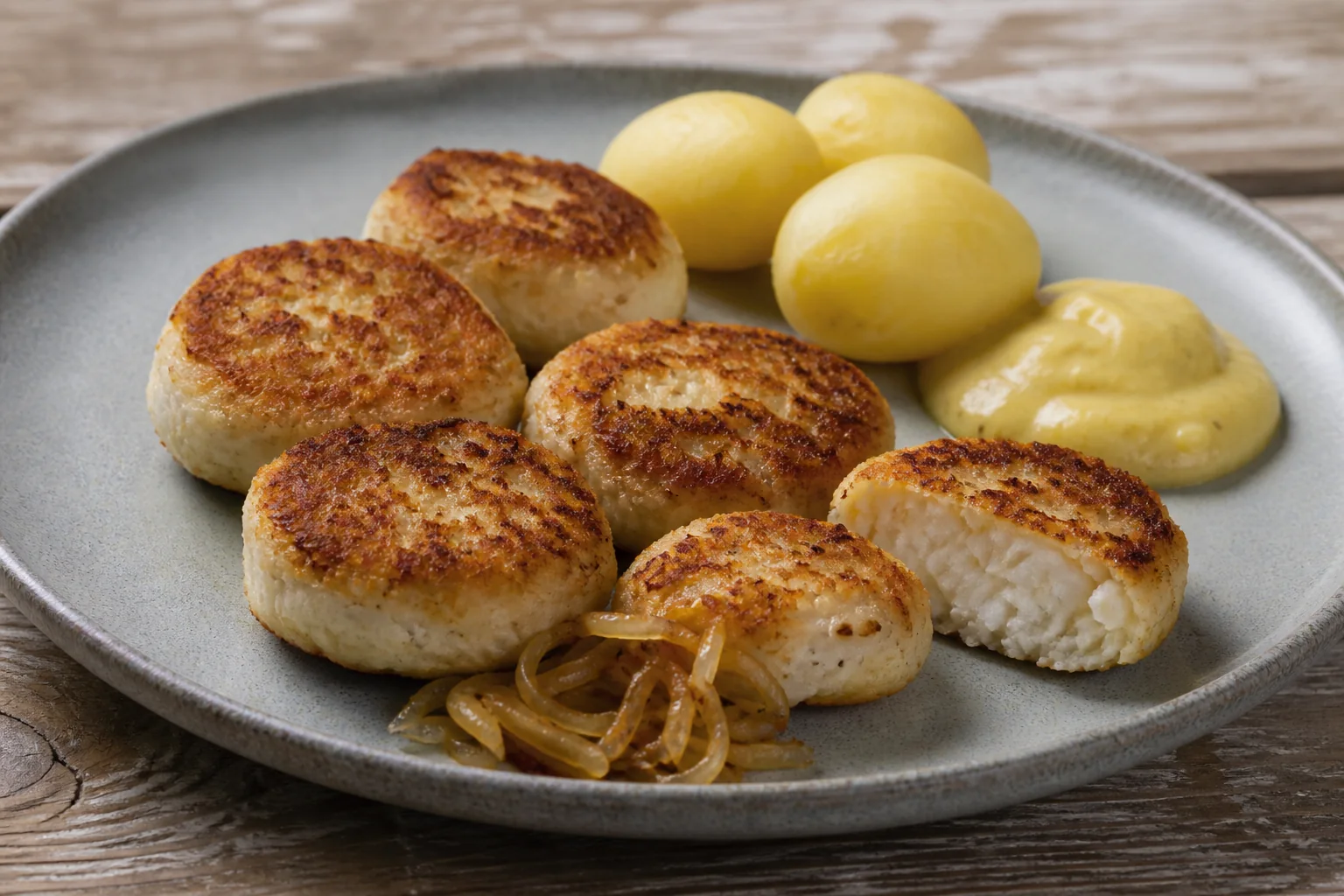
Icelandic fish balls
A crisp, golden crust around tender white fish, served with boiled potatoes, soft onions, and mild curry sauce.
MexicoFilled tortilla
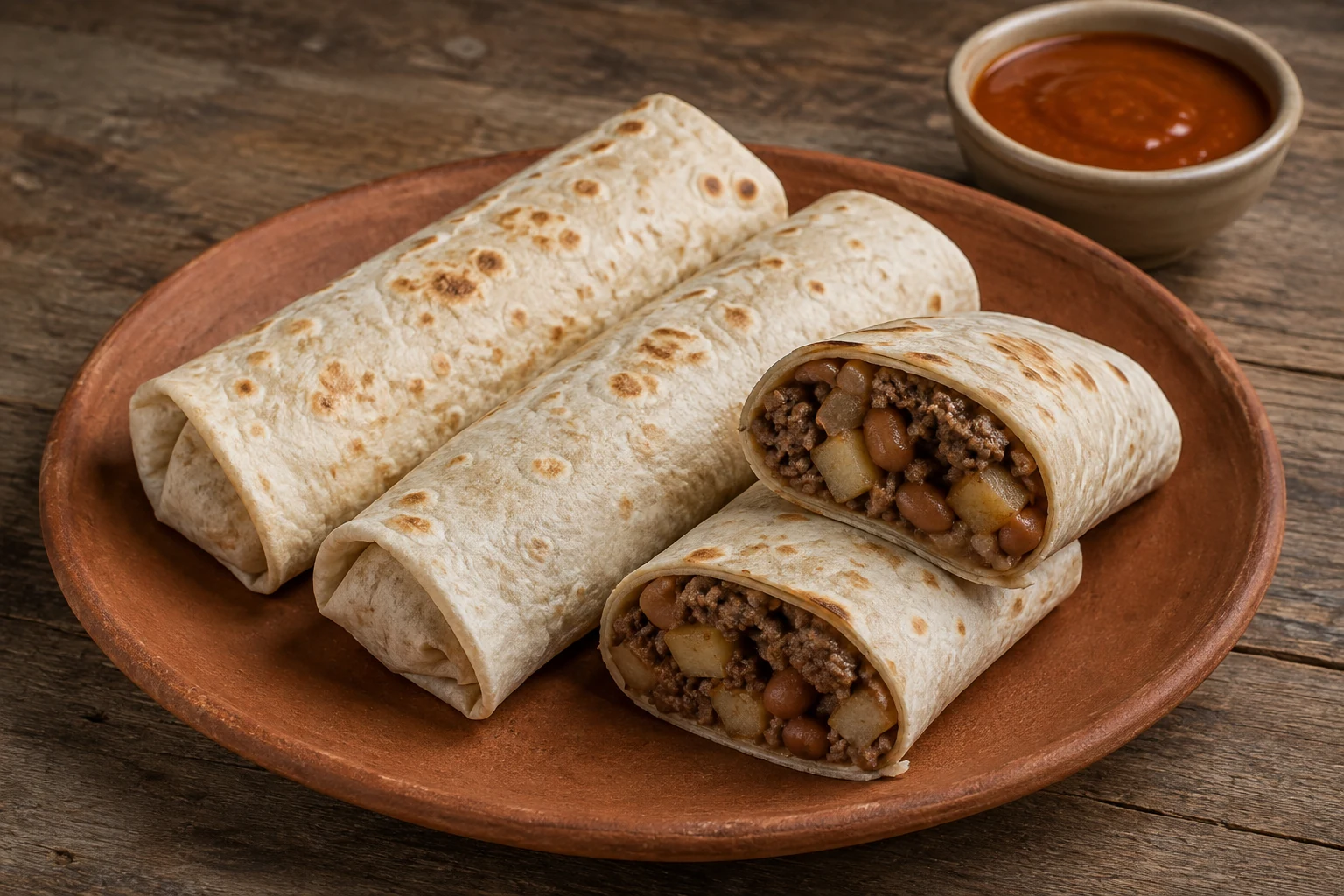
Mexican Burrito
A guide to the slender flour-tortilla burritos of northern Mexico, their varied regional fillings, and a practical beef, potato, and bean recipe.
LebanonGathering table
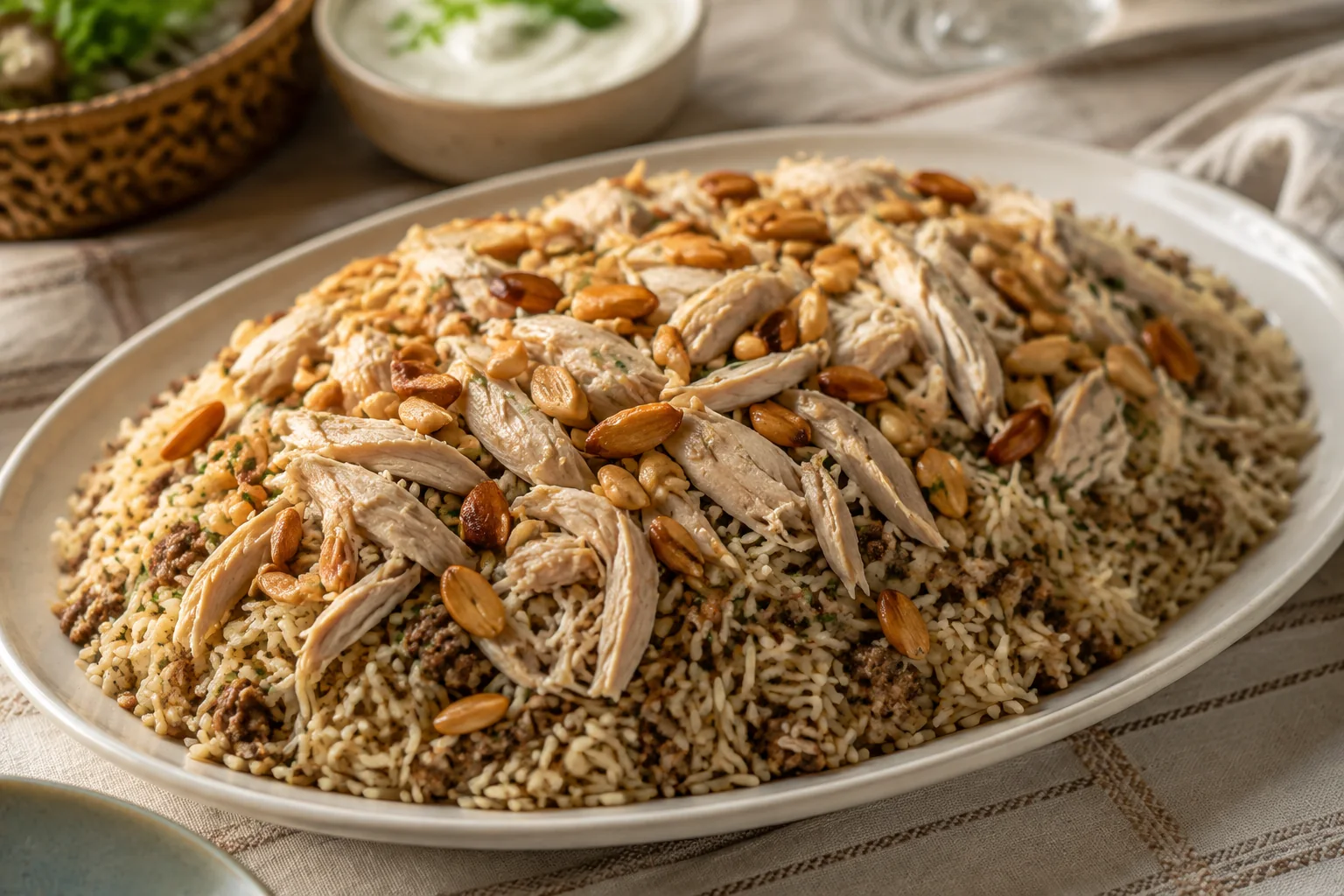
Riz bi Djej
Fragrant rice and finely browned meat, crowned with tender chicken and a generous scatter of toasted nuts.